Eating is an everyday blessing that Muslims are encouraged to appreciate. In Islam, finishing a meal is an opportunity to remember Allah, express gratitude for His provision and acknowledge that food and nourishment come from Him.
The dua after eating is a supplication recited when a person finishes their food. Prophet Muhammad (peace be upon him) taught words of praise and thanks to Allah after meals, and several authentic narrations describe these supplications.
Whether you are learning the after-eating dua for the first time or teaching it to your children, knowing its Arabic wording, English transliteration and meaning can help you make this Sunnah part of your daily routine.
What Is the Dua After Eating in Islam?
The dua after eating is a prayer of gratitude recited after finishing a meal. One of the supplications reported from Prophet Muhammad (peace be upon him) is:
Arabic:
الْحَمْدُ لِلَّهِ الَّذِي أَطْعَمَنِي هَذَا وَرَزَقَنِيهِ مِنْ غَيْرِ حَوْلٍ مِنِّي وَلَا قُوَّةٍ
English Transliteration:
Alhamdu lillahil-ladhi at'amani hadha wa razaqanihi min ghayri hawlin minni wa la quwwah.
English Translation:
"All praise is due to Allah, Who has fed me this and provided it for me without any power or strength on my part."
Hadith Reference: Sunan Abi Dawud 4023 and Jami' at-Tirmidhi 3458.
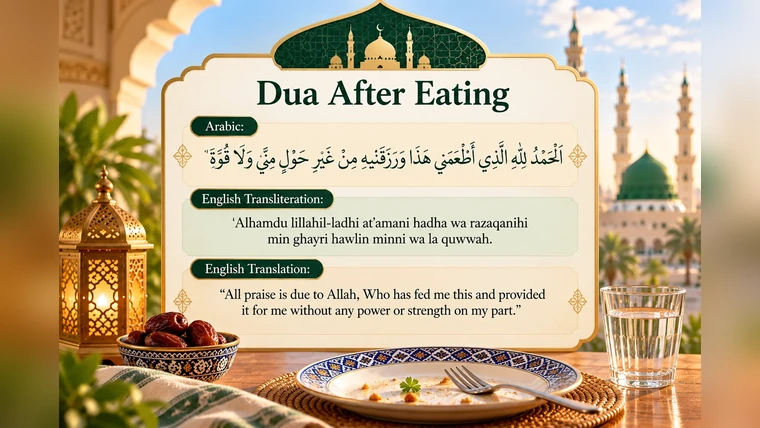
This supplication acknowledges that food is a provision from Allah, not something a person obtains entirely through their own ability. It combines gratitude for a meal with recognition of dependence upon Allah.
The narration also mentions forgiveness of previous sins for the person who recites this praise. This virtue should be understood in the context of the Hadith and Islamic teachings on repentance and forgiveness, rather than as permission to continue wrongdoing.
Dua After Eating in Arabic With English Translation
Another well-known supplication after eating is recorded in Sahih al-Bukhari.
Arabic:
الْحَمْدُ لِلَّهِ الَّذِي كَفَانَا وَأَرْوَانَا غَيْرَ مَكْفِيٍّ وَلَا مَكْفُورٍ
English Transliteration:
Alhamdu lillahil-ladhi kafana wa arwana, ghayra makfiyyin wa la makfur.
English Translation:
"All praise is due to Allah, Who has satisfied us and quenched our thirst, and Whose favours cannot be adequately repaid or denied."
Hadith Reference: Sahih al-Bukhari 5459.
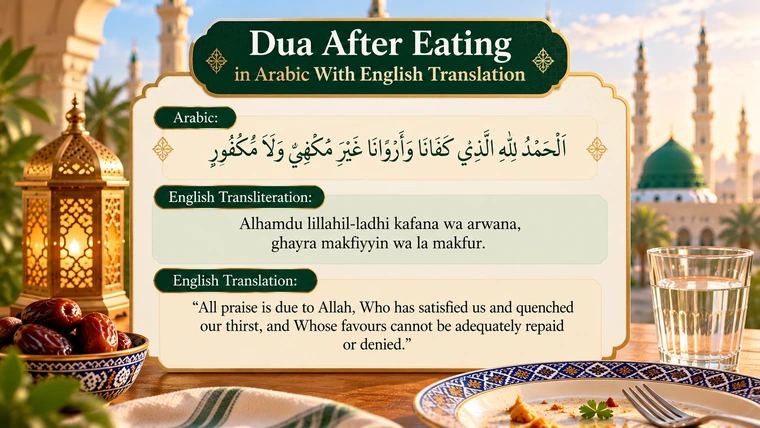
This dua expresses appreciation for both food and drink. It reminds Muslims that the ability to eat, drink and feel satisfied is itself a blessing.
The two supplications above are different reported forms of praise after eating. Muslims can learn either one, and they do not need to combine them into a single fixed prayer.
Meaning of the Dua After Eating
The meaning of the dua after eating centres on gratitude, humility and recognition of Allah's blessings.
When a Muslim says Alhamdulillah after a meal, they praise Allah for the food they have received. The longer supplications expand upon this gratitude by recognising that Allah provides nourishment and makes it possible for people to benefit from His creation.
Three important lessons can be drawn from these words:
Gratitude: Thanking Allah for food, drink and the ability to enjoy a meal.
Humility: Recognising that personal effort alone does not account for every blessing received.
Remembrance: Making the remembrance of Allah part of ordinary daily activities.
The Quran also encourages gratitude for lawful provision:
"Eat of the good things We have provided for you, and be grateful to Allah, if it is Him that you worship."
Quran Reference: Surah Al-Baqarah 2:172.
Reciting a dua after eating is therefore more than repeating memorised words. Understanding its meaning helps turn a daily habit into a conscious expression of thanks.
Is the Dua After Eating Sunnah?
Yes. Praising Allah after eating is established in the Sunnah of Prophet Muhammad (peace be upon him).
Anas ibn Malik (may Allah be pleased with him) reported that the Prophet said:
"Allah is pleased with His servant who says Alhamdulillah when he eats something and says Alhamdulillah when he drinks something."
Hadith Reference: Sahih Muslim 2734a.
This Hadith highlights the importance of thanking Allah after receiving food and drink. It also shows that even a short expression of praise carries spiritual significance.
Muslims can say Alhamdulillah after eating, while the longer supplications reported in the Hadith provide additional words of gratitude to learn and recite.
Reciting these duas is recommended, not obligatory, to complete a meal. A person who forgets the supplication has not invalidated their food or sinned merely by forgetting it.
When Should You Recite the Dua After Eating?
Recite the dua after you finish your meal. Islamic eating etiquette also includes remembering Allah at the beginning of a meal through the dua before eating, while the supplications discussed here are recited afterwards.
You do not need to wait a certain number of minutes or perform a separate ritual before making the supplication. You can recite it after breakfast, lunch, dinner, or any other meal.
For example, a Muslim may recite it:
After finishing a meal at home.
After eating at work, school or while travelling.
After sharing food with family or friends.
After completing a meal during Ramadan.
After eating food provided by a host.
The main purpose remains the same in each situation: to praise Allah for His provision.
A Muslim who is still learning Arabic can begin by memorising Alhamdulillah and gradually learning the longer authentic supplications with their meanings.
Other Authentic Duas After Eating
Prophet Muhammad (peace be upon him) taught different supplications for praising Allah after meals. These prayers express gratitude for food, recognise Allah's generosity and remind Muslims that everyday nourishment is a blessing.
The dua after eating does not have to be limited to one particular wording. Several supplications are reported in authentic Hadith, and learning them helps Muslims understand different expressions of gratitude.
Another Dua After Finishing a Meal
Abu Umamah (may Allah be pleased with him) narrated that the Prophet would recite the following words when his dining sheet was removed after eating.
Arabic:
الْحَمْدُ لِلَّهِ كَثِيرًا طَيِّبًا مُبَارَكًا فِيهِ، غَيْرَ مَكْفِيٍّ، وَلَا مُوَدَّعٍ وَلَا مُسْتَغْنًى عَنْهُ، رَبَّنَا
English Transliteration:
Alhamdu lillahi kathiran tayyiban mubarakan fihi, ghayra makfiyyin wa la muwadda'in wa la mustaghnan 'anhu, Rabbana.
English Translation:
"All praise is due to Allah, abundant, good and blessed praise. Our Lord, we can never adequately repay Your favours, abandon You or be independent of You."
Hadith Reference: Sahih al-Bukhari 5458.
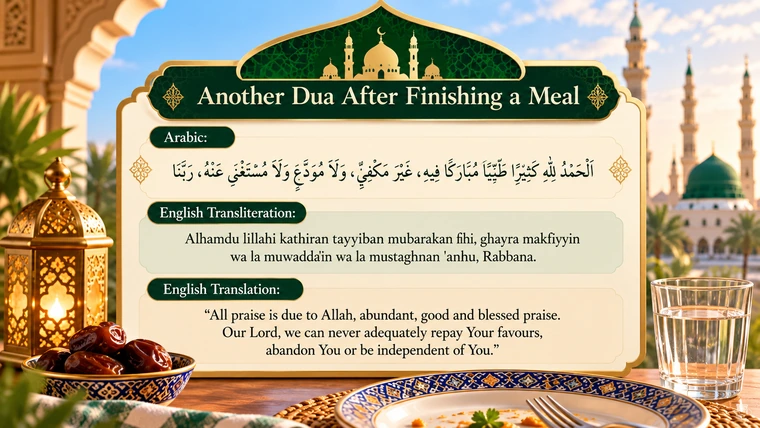
This supplication recognises that Allah's blessings are greater than anything people can repay. Food may be earned, prepared and served through human effort, but the resources and opportunities behind it ultimately come from Allah.
The wording also reflects continued dependence upon Allah, even after a person's immediate needs have been satisfied.
Benefits of Reciting Dua After Eating
Reciting the dua after eating is a simple act of worship that encourages gratitude and remembrance of Allah throughout the day.
Islamic teachings support its benefits, though specific spiritual rewards should be attributed to a supplication only when reliable evidence establishes them.
1. Earning Allah's Pleasure Through Gratitude
Sahih Muslim mentions one of the clearest benefits of praising Allah after food.
Anas ibn Malik (may Allah be pleased with him) narrated that Prophet Muhammad (peace be upon him) said:
"Allah is pleased with His servant who praises Him after eating or drinking."
Hadith Reference: Sahih Muslim 2734a.
This narration demonstrates that thanking Allah for an ordinary meal is a meaningful act of worship.
2. Remembering Allah in Everyday Life
Remembering Allah is not limited to formal prayers. Muslims are encouraged to maintain awareness of Him during everyday activities, including eating and drinking.
Reciting Alhamdulillah after food creates a regular opportunity for remembrance without requiring a lengthy supplication.
3. Developing Gratitude for Food and Provision
Food is an everyday necessity, but we should not take access to sufficient nourishment for granted.
Saying the after-eating dua encourages Muslims to recognise the value of their meals and appreciate those who prepare and provide them.
4. Teaching Children Thankfulness
When parents regularly recite a dua after eating, children can gradually learn the same practice.
Repeating the words after family meals gives you a chance to teach both Arabic pronunciation and the importance of thanking Allah.
Dua After Eating for Forgiveness of Sins
Some Muslims search for a dua after eating that is associated with forgiveness of sins.
A narration reported in Jami' at-Tirmidhi describes a supplication beginning with:
Arabic:
الْحَمْدُ لِلَّهِ الَّذِي أَطْعَمَنِي هَذَا وَرَزَقَنِيهِ مِنْ غَيْرِ حَوْلٍ مِنِّي وَلَا قُوَّةٍ
English Transliteration:
Alhamdu lillahil-ladhi at'amani hadha wa razaqanihi min ghayri hawlin minni wa la quwwah.
English Translation:
"All praise is due to Allah, Who has fed me this and provided it for me without any power or strength on my part."
Hadith Reference: Jami' at-Tirmidhi 3458.
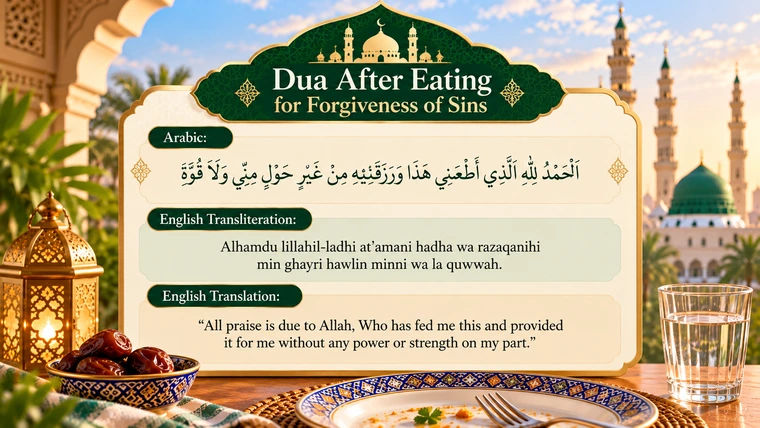
The narration mentions forgiveness of previous sins for the person who recites this supplication after eating.
However, this should not be interpreted as a guarantee that all major sins are automatically forgiven without repentance. Islamic teachings distinguish between different categories of sins and emphasise sincere repentance.
The supplication was already presented in Part 1. Its mention here highlights the forgiveness-related narration rather than introducing a separate dua.
Dua After Eating at Someone's House
When a Muslim eats at another person's home, thanking Allah for the meal and showing appreciation to the host are both important.
Along with the usual dua after eating, Prophet Muhammad (peace be upon him) made supplications for those who provided him with food and drink.
Dua for Someone Who Provides Food
Arabic:
اللَّهُمَّ أَطْعِمْ مَنْ أَطْعَمَنِي وَأَسْقِ مَنْ أَسْقَانِي
English Transliteration:
Allahumma at'im man at'amani wa asqi man asqani.
English Translation:
"O Allah, feed whoever has fed me and give drink to whoever has given me drink."
Hadith Reference: Sahih Muslim 2055a.
This supplication asks Allah to reward the generosity of someone who has provided food or drink.
Recite it when thanking a host after a meal, whether the occasion is a family gathering, an invitation from friends, or another act of hospitality.
Another Supplication for a Host
The Prophet (peace be upon him) also recited the following supplication after eating food a host provided.
Arabic:
أَفْطَرَ عِنْدَكُمُ الصَّائِمُونَ وَأَكَلَ طَعَامَكُمُ الْأَبْرَارُ وَصَلَّتْ عَلَيْكُمُ الْمَلَائِكَةُ
English Transliteration:
Aftara 'indakumus-sa'imun, wa akala ta'amakumul-abrar, wa sallat 'alaykumul-mala'ikah.
English Translation:
"May fasting people break their fast with you, may righteous people eat your food, and may the angels invoke blessings upon you."
Hadith Reference: Sunan Abi Dawud 3854, graded Sahih by Al-Albani.
This supplication is especially meaningful when someone offers hospitality during Ramadan, although the reported occasion involved an ordinary meal of bread and olive oil.
It is a prayer for the host's blessings, not a replacement for the usual words of praise to Allah after eating.
Sunnah Etiquette After Finishing Food
Islamic eating etiquette extends beyond the meal itself. The way Muslims finish eating can also reflect gratitude, cleanliness and consideration for others.
The following practices help maintain good manners after food:
Praise Allah: Say Alhamdulillah or recite an authentic dua after eating.
Avoid unnecessary waste: Avoid discarding usable food without good reason.
Maintain cleanliness: Clean your hands and eating area after finishing.
Thank the person who served the meal: Express appreciation for their effort and hospitality.
Remember those in need: Let gratitude for your own meal encourage generosity towards others.
These practices support the broader Islamic principles of thankfulness and responsible behaviour.
You don't need to turn every meal into a complicated routine. A sincere expression of praise, followed by considerate behaviour, helps make gratitude a natural part of everyday life.
Can You Say Alhamdulillah Instead of a Longer Dua?
Yes. Saying Alhamdulillah after eating is an established expression of gratitude to Allah.
The Hadith in Sahih Muslim 2734a establishes the virtue of praising Allah after food and drink without requiring every Muslim to memorise a particular lengthy supplication.
Arabic:
الْحَمْدُ لِلَّهِ
English Transliteration:
Alhamdulillah.
English Translation:
"All praise is due to Allah."
Those who have not yet memorised the longer duas can begin with these words.
Learning additional authentic supplications is beneficial, but understanding and sincerely expressing gratitude remains central to the practice.
Dua After Eating for Kids
Teaching children the dua after eating is a simple way to introduce gratitude and Islamic manners into their daily routine. Parents can begin with a short phrase and gradually introduce longer supplications as their children become more confident.
A suitable starting point is Alhamdulillah, which means "All praise is due to Allah."
Arabic:
الْحَمْدُ لِلَّهِ
English Transliteration:
Alhamdulillah.
English Translation:
"All praise is due to Allah."
The Prophet Muhammad (peace be upon him) taught the importance of praising Allah after eating and drinking, as recorded in Sahih Muslim 2734a.
Children do not need to memorise every longer supplication immediately. Learning the meaning of Alhamdulillah and saying it sincerely after meals provides a useful foundation.
How to Teach Children the Dua After Eating
Parents and teachers can make learning easier through everyday repetition.
Start with Alhamdulillah: Encourage children to say it when they finish their meal.
Explain the meaning: Tell them that they are thanking Allah for their food.
Practise together: Recite the dua aloud after family meals.
Introduce Arabic gradually: Teach longer supplications in small sections when the child is ready.
Encourage understanding: Help children recognise food as a blessing rather than simply memorising words.
Consistency is more helpful than expecting perfect pronunciation immediately. The aim is to build a lasting habit of gratitude.
Dua After Eating During Ramadan
During Ramadan, Muslims continue to praise Allah after eating, just as they do throughout the rest of the year.
The regular dua after eating can be recited after suhoor, iftar or another meal. You don't need to replace it with a different supplication just because the meal takes place during Ramadan.
However, it is important to distinguish between a dua associated with breaking the fast and a supplication recited after finishing food.
Dua After Eating Iftar
Iftar is the meal Muslims eat to break their fast at sunset. The Prophet Muhammad (peace be upon him) is reported to have recited the following supplication upon breaking his fast:
Arabic:
ذَهَبَ الظَّمَأُ وَابْتَلَّتِ الْعُرُوقُ وَثَبَتَ الْأَجْرُ إِنْ شَاءَ اللَّهُ
English Transliteration:
Dhahabaz-zama'u wabtallatil-'urooqu wa thabatal-ajru in sha Allah.
English Translation:
"The thirst has gone, the veins are moistened, and the reward is confirmed, if Allah wills."
Hadith Reference: Sunan Abi Dawud 2357, graded Hasan by Al-Albani.
This supplication is associated with breaking the fast, as discussed in the dua to open fast, and is distinct from the general dua recited after finishing a meal.
After finishing iftar, Muslims may also say Alhamdulillah or recite one of the authentic after-meal supplications mentioned earlier in this article.
Dua After Eating Suhoor
Suhoor, also known as sehri, is the pre-dawn meal eaten before beginning the daily fast in Ramadan. The dua to close fast relates to the intention to fast, whereas the dua after eating expresses gratitude to Allah for the meal.
There is no separate, specifically established dua that Muslims must recite after finishing suhoor. The usual words of praise after eating remain appropriate.
For example, a person may say:
Arabic:
الْحَمْدُ لِلَّهِ
English Transliteration:
Alhamdulillah.
English Translation:
"All praise is due to Allah."
The Prophet Muhammad (peace be upon him) encouraged Muslims to eat suhoor because it contains blessings.
Hadith Reference: Sahih al-Bukhari 1923.
The blessings of suhoor and the general Sunnah of praising Allah after meals are related teachings, but they should not be presented as evidence for a separate prescribed suhoor supplication.
Dua After Eating and Drinking
Islamic teachings encourage Muslims to thank Allah for both food and drink.
The Hadith narrated by Anas ibn Malik (may Allah be pleased with him) states that Allah is pleased with a servant who praises Him after eating or drinking.
Hadith Reference: Sahih Muslim 2734a.
This means that saying Alhamdulillah after drinking water or another permissible drink is also an expression of gratitude.
You can learn longer supplications after meals alongside this simple practice, helping Muslims remember Allah throughout the day.
Making Dua After Eating Part of Your Daily Sunnah
The dua after eating is a meaningful Sunnah that encourages Muslims to recognise Allah's blessings after receiving food and drink.
Whether a person says Alhamdulillah or recites a longer supplication from authentic Hadith, the purpose is to express sincere gratitude for Allah's provision.
Learning the Arabic wording, English transliteration, and meaning can help make this practice easier for adults and children alike.
By remembering Allah after meals, Muslims can turn an ordinary daily activity into an opportunity for worship, reflection and thankfulness.