

The first words Muslims are encouraged to say upon hearing the news of someone's death are:
إِنَّا لِلَّٰهِ وَإِنَّا إِلَيْهِ رَاجِعُونَ
Transliteration:Innā lillāhi wa innā ilayhi rājiʿūn.
English Translation:Indeed, we belong to Allah, and indeed, to Him we will return.
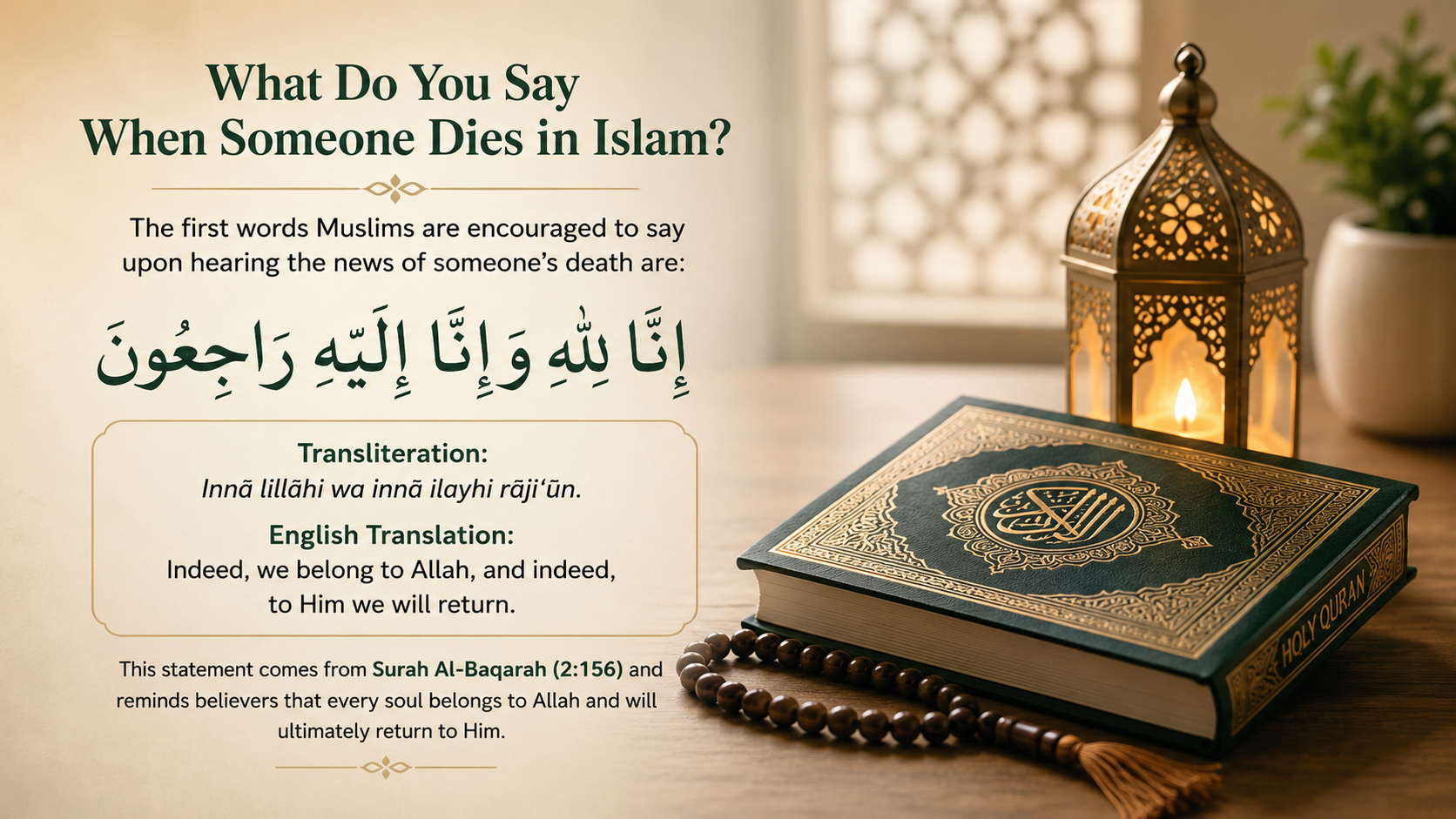
This statement comes from Surah Al-Baqarah (2:156) and reminds believers that every soul belongs to Allah and will ultimately return to Him. Muslims say this phrase to express patience, acceptance of Allah's decree, and trust in His wisdom.
Download Islamic Duas for the Deceased
Whether the deceased is a family member, friend, neighbor, or fellow Muslim, saying "Innā lillāhi wa innā ilayhi rājiʿūn" is the most common and authentic Islamic response.
Why Do Muslims Say "Innā Lillāhi Wa Innā Ilayhi Rājiʿūn"?
Islam teaches that life and death are part of Allah's divine plan. The Quran reminds believers that every soul will experience death before returning to its Creator.
By saying:
إِنَّا لِلَّٰهِ وَإِنَّا إِلَيْهِ رَاجِعُونَ
Muslims acknowledge three important beliefs:
Allah is the Creator and Owner of every soul.
Death is a transition to the Hereafter, not the end of existence.
Believers should respond to loss with patience, faith, and remembrance of Allah.
This simple phrase provides comfort during grief while reinforcing one of Islam's core beliefs: every human being will return to Allah.
What Does "Innā Lillāhi Wa Innā Ilayhi Rājiʿūn" Mean?
The phrase can be understood in three parts.
إِنَّا (Innā)
Meaning:Indeed, we.
This confirms the statement with certainty.
لِلَّٰهِ (Lillāh)
Meaning:Belong to Allah.
Everything in creation belongs to Allah, including every human life.
وَإِنَّا إِلَيْهِ رَاجِعُونَ (Wa Innā Ilayhi Rājiʿūn)
Meaning:And indeed, to Him we will return.
Every person will eventually meet Allah after death and be accountable for their deeds.
Together, the phrase reminds Muslims that worldly life is temporary and that returning to Allah is inevitable.
What Do You Say to the Family of Someone Who Has Died in Islam?
When offering condolences, Muslims should choose words that comfort the grieving family and encourage patience without making assumptions about Allah's judgment.
Suitable Islamic condolences include:
May Allah forgive your loved one and grant them Jannah.
May Allah reward your patience and give you strength during this difficult time.
May Allah shower His mercy upon the deceased and make their grave spacious and filled with light.
May Allah reunite you with your loved one in Jannatul Firdaus.
May Allah replace your loss with something better and grant your family peace.
These sincere prayers are consistent with Islamic teachings because they ask Allah for mercy, forgiveness, and patience rather than making definitive statements about the deceased's final status.
Authentic Dua for Someone Who Has Died
One of the well-known supplications for the deceased is:
اللَّهُمَّ اغْفِرْ لَهُ وَارْحَمْهُ وَعَافِهِ وَاعْفُ عَنْهُ
Transliteration:
Allāhumma-ghfir lahu warḥamhu wa ʿāfihi waʿfu ʿanhu.
English Translation:
O Allah, forgive him, have mercy on him, grant him well-being, and pardon him.
This authentic supplication asks Allah for forgiveness, mercy, protection, and pardon for the deceased. If the deceased is female, the pronouns are changed accordingly.
What Prayer Do Muslims Say When Someone Dies?
Besides saying "Innā lillāhi wa innā ilayhi rājiʿūn," Muslims are encouraged to make sincere supplication for the deceased.
A simple and meaningful prayer is:
اللَّهُمَّ اغْفِرْ لَهُ وَارْحَمْهُ
Transliteration:
Allāhumma-ghfir lahu warḥamhu.
English Translation:
O Allah, forgive him and have mercy on him.
For a female, replace له (lahu) with لها (lahā).
Even short, heartfelt duas are valuable because the Prophet Muhammad ﷺ encouraged believers to pray sincerely for those who have passed away.
Is Saying "Innā Lillāhi Wa Innā Ilayhi Rājiʿūn" Obligatory?
No. Saying this phrase is not obligatory (fard), but it is a highly recommended Sunnah response when hearing news of death or any significant calamity.
The Quran praises those who respond to hardship by remembering Allah and saying:
إِنَّا لِلَّٰهِ وَإِنَّا إِلَيْهِ رَاجِعُونَ
Believers who respond with patience and trust in Allah are promised His mercy and guidance.
What Should Muslims Avoid Saying?
Islam encourages believers to speak words that bring comfort and hope while avoiding statements that contradict Islamic teachings.
Avoid making definitive claims such as:
"They are definitely in Paradise."
"Allah needed another angel."
"Everything happens for a reason," if it dismisses the family's grief.
Any statement that questions Allah's wisdom or decree.
Instead, pray for the deceased, support the grieving family, and remember Allah through sincere supplication.
What Does the Quran Say About Death?
The Quran teaches that death is a certainty for every human being. No one can escape it, regardless of age, wealth, or status. Islam encourages believers to prepare for the Hereafter through faith, righteous deeds, and sincere repentance.
Every Soul Will Taste Death
Allah says:
كُلُّ نَفْسٍ ذَائِقَةُ الْمَوْتِ
Transliteration:Kullu nafsin dhā'iqatu al-mawt.
English Translation:Every soul shall taste death.
Reference: Surah Aal 'Imran (3:185)
This verse reminds Muslims that death is a universal reality. It also encourages believers to focus on their relationship with Allah rather than becoming overly attached to worldly life.
Death Happens Only by Allah's Permission
Allah says:
وَمَا كَانَ لِنَفْسٍ أَنْ تَمُوتَ إِلَّا بِإِذْنِ اللَّهِ كِتَابًا مُؤَجَّلًا
Transliteration:Wa mā kāna linafsin an tamūta illā bi-idhnillāhi kitāban mu'ajjalā.
English Translation:No soul can ever die except by Allah's permission at an appointed time.
Reference: Surah Aal 'Imran (3:145)
This verse teaches Muslims that every person's lifespan has already been determined by Allah. Death cannot come early or be delayed beyond its appointed time.
Patience During Loss Brings Allah's Mercy
Allah describes the believers who respond to hardship with patience:
الَّذِينَ إِذَا أَصَابَتْهُمْ مُصِيبَةٌ قَالُوا إِنَّا لِلَّهِ وَإِنَّا إِلَيْهِ رَاجِعُونَ أُولَٰئِكَ عَلَيْهِمْ صَلَوَاتٌ مِنْ رَبِّهِمْ وَرَحْمَةٌ وَأُولَٰئِكَ هُمُ الْمُهْتَدُونَ
English Translation:
Those who, when disaster strikes them, say, "Indeed we belong to Allah, and indeed to Him we will return." They are the ones upon whom are blessings and mercy from their Lord, and they are the rightly guided.
Reference: Surah Al-Baqarah (2:156–157)
These verses explain why Muslims immediately say "Innā lillāhi wa innā ilayhi rājiʿūn" after hearing the news of someone's death. It is a declaration of faith, patience, and trust in Allah.
Authentic Hadith About Patience After Death
The Prophet Muhammad ﷺ taught Muslims to remain patient when facing the loss of a loved one.
One of the most well-known sayings is:
"Patience is at the first strike of calamity."
Reference: Sahih al-Bukhari and Sahih Muslim
This Hadith emphasizes that true patience is shown when the loss first occurs. Although grief is natural, believers are encouraged to avoid words or actions that express anger toward Allah's decree.
Another authentic narration teaches believers to make dua for the deceased because the prayers of fellow Muslims benefit them by Allah's permission.
For this reason, attending the funeral prayer (Salat al-Janazah), asking Allah to forgive the deceased, and supporting the bereaved family are all highly encouraged acts in Islam.
How to Offer Islamic Condolences
Islam encourages condolences that comfort the family while reminding them to remain patient and hopeful in Allah's mercy.
A Muslim offering condolences should:
Say "Innā lillāhi wa innā ilayhi rājiʿūn" upon hearing the news.
Pray for Allah's forgiveness and mercy for the deceased.
Pray that Allah grants patience (Sabr) to the family.
Visit or contact the grieving family if possible.
Offer practical help, such as preparing food or assisting with daily responsibilities.
Keep conversations respectful and avoid unnecessary questions about the circumstances of death.
Simple acts of kindness often provide more comfort than long speeches.
Islamic Condolence Messages
If you are unsure what to say, these respectful messages are appropriate.
1. General Condolence
May Allah forgive your loved one, have mercy upon them, and grant them the highest place in Jannah. May He also grant you patience and strength during this difficult time.
2. Short Islamic Message
إِنَّا لِلَّٰهِ وَإِنَّا إِلَيْهِ رَاجِعُونَ
Indeed, we belong to Allah, and to Him we shall return.
May Allah bless the deceased with His mercy and grant your family patience.
3. Condolence for a Friend
May Allah ease your grief, forgive your loved one, illuminate their grave, and reunite you in Jannatul Firdaus.
4. Condolence for Parents
May Allah reward your patience, forgive your parent, expand their grave, and admit them into Paradise without accountability.
5. Professional Islamic Condolence
Please accept my sincere condolences. May Allah forgive the deceased, shower them with His mercy, and grant comfort and patience to your entire family.
Can You Say "Rest in Peace" in Islam?
Many Muslims prefer making dua instead of simply saying "Rest in Peace (RIP)."
Phrases such as the following are generally considered more appropriate because they are direct supplications to Allah:
May Allah forgive them.
May Allah have mercy on them.
May Allah grant them Jannatul Firdaus.
May Allah make their grave spacious and full of light.
These expressions align more closely with Islamic teachings by asking Allah for mercy and forgiveness rather than making assumptions about the deceased's condition.
Can Non-Muslims Say Islamic Condolences?
Yes. A non-Muslim who wishes to show respect may say:
My sincere condolences.
I am sorry for your loss.
May God grant your family peace and comfort.
If they are comfortable using the traditional Islamic phrase, they may respectfully say:
إِنَّا لِلَّٰهِ وَإِنَّا إِلَيْهِ رَاجِعُونَ
This phrase expresses belief that all people ultimately return to their Creator and is widely recognized among Muslims as a respectful response to death.
What Is the Reward for Being Patient After the Death of a Loved One?
Islam teaches that patience during hardship is among the greatest acts of worship.
Those who remain patient, avoid complaining against Allah's decree, and continue to place their trust in Him are promised His mercy, guidance, and reward.
The loss of a loved one is undoubtedly painful, but Islam encourages believers to transform grief into worship by remembering Allah, making dua for the deceased, giving charity on their behalf where appropriate, and maintaining hope in Allah's infinite mercy.
Understanding the Islamic Response to Death
The Islamic response to someone's death is rooted in faith, patience, and sincere remembrance of Allah. The first words Muslims are encouraged to say are:
إِنَّا لِلَّٰهِ وَإِنَّا إِلَيْهِ رَاجِعُونَ
Transliteration:Innā lillāhi wa innā ilayhi rājiʿūn.
English Translation:Indeed, we belong to Allah, and indeed, to Him we will return.
This Quranic phrase reminds believers that every soul belongs to Allah and will ultimately return to Him. Along with these words, Muslims are encouraged to pray for the deceased by asking Allah to forgive them, have mercy on them, expand and illuminate their grave, and admit them into Jannatul Firdaus.
Supporting the grieving family with kind words, sincere prayers, and practical assistance reflects the compassion and brotherhood that Islam encourages. While death is one of life's greatest trials, the Quran and Sunnah teach believers to face it with patience (Sabr), trust in Allah's wisdom, and hope in His infinite mercy. Through remembrance of Allah, heartfelt supplication, and continued good deeds, Muslims honor the deceased while strengthening their own faith in the promise of the Hereafter.