

The dua for fasting is not a single fixed supplication required for a fast to be valid. Before fasting, the essential requirement is a sincere niyyah (intention) in the heart. While fasting, a Muslim can make dua for forgiveness, guidance, mercy, and other permissible needs. At Iftar, an established supplication reported from the Prophet Muhammad ﷺ is "Dhahaba al-zama’u wabtallatil-‘urooqu wa thabatal-ajru in sha’ Allah," meaning, "The thirst has gone, the veins are moistened, and the reward is assured, if Allah wills."
This guide focuses on duas connected with fasting as a whole, including what to say while fasting and when you may make dua. The intention before fasting and the supplication at Iftar are separate matters and should not be treated as one dua.
Is There a Specific Dua for Fasting?
There is no single fixed dua that a Muslim must recite throughout a fast. Fasting involves different stages, and dua plays a different role at each stage.
Before the fast begins, a Muslim intends to fast for Allah. The intention is fundamentally an act of the heart and does not require a particular Arabic sentence to be spoken.
During the fast, a Muslim may make personal duas and ask Allah for any permissible good.
When the fast is broken, an established supplication reported from Abdullah ibn Umar (RA) is:
Arabic:
ذَهَبَ الظَّمَأُ وَابْتَلَّتِ الْعُرُوقُ وَثَبَتَ الْأَجْرُ إِنْ شَاءَ اللَّهُ
Transliteration:
Dhahaba al-zama’u wabtallatil-‘urooqu wa thabatal-ajru in sha’ Allah.
English Meaning:
"The thirst has gone, the veins are moistened, and the reward is assured, if Allah wills."
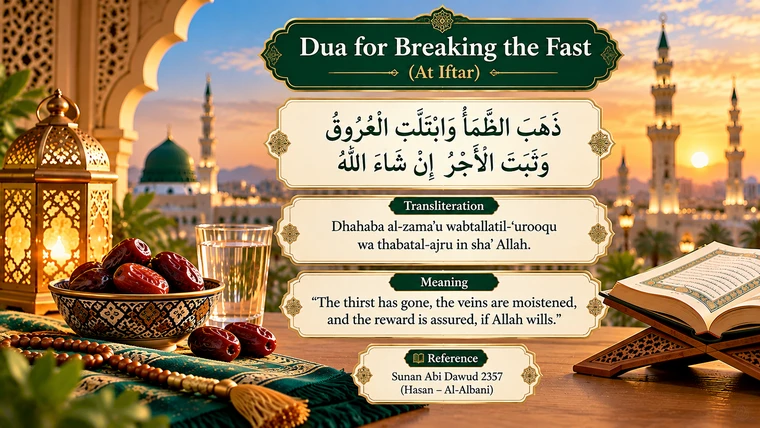
This is reported in Sunan Abi Dawud 2357 from Abdullah ibn Umar (RA). Al-Albani graded the narration Hasan (good).
The intention before fasting and this supplication at Iftar therefore serve different purposes.
Dua Before Fasting
Before beginning a fast, the main requirement is the niyyah, meaning the intention to fast. A particular spoken dua is not required to establish that intention.
A commonly recited wording is:
Arabic:
نَوَيْتُ صَوْمَ غَدٍ لِلّٰهِ تَعَالَى
Transliteration:
Nawaytu sawma ghadin lillahi ta‘ala.
English Meaning:
"I intend to fast tomorrow for the sake of Allah Almighty."
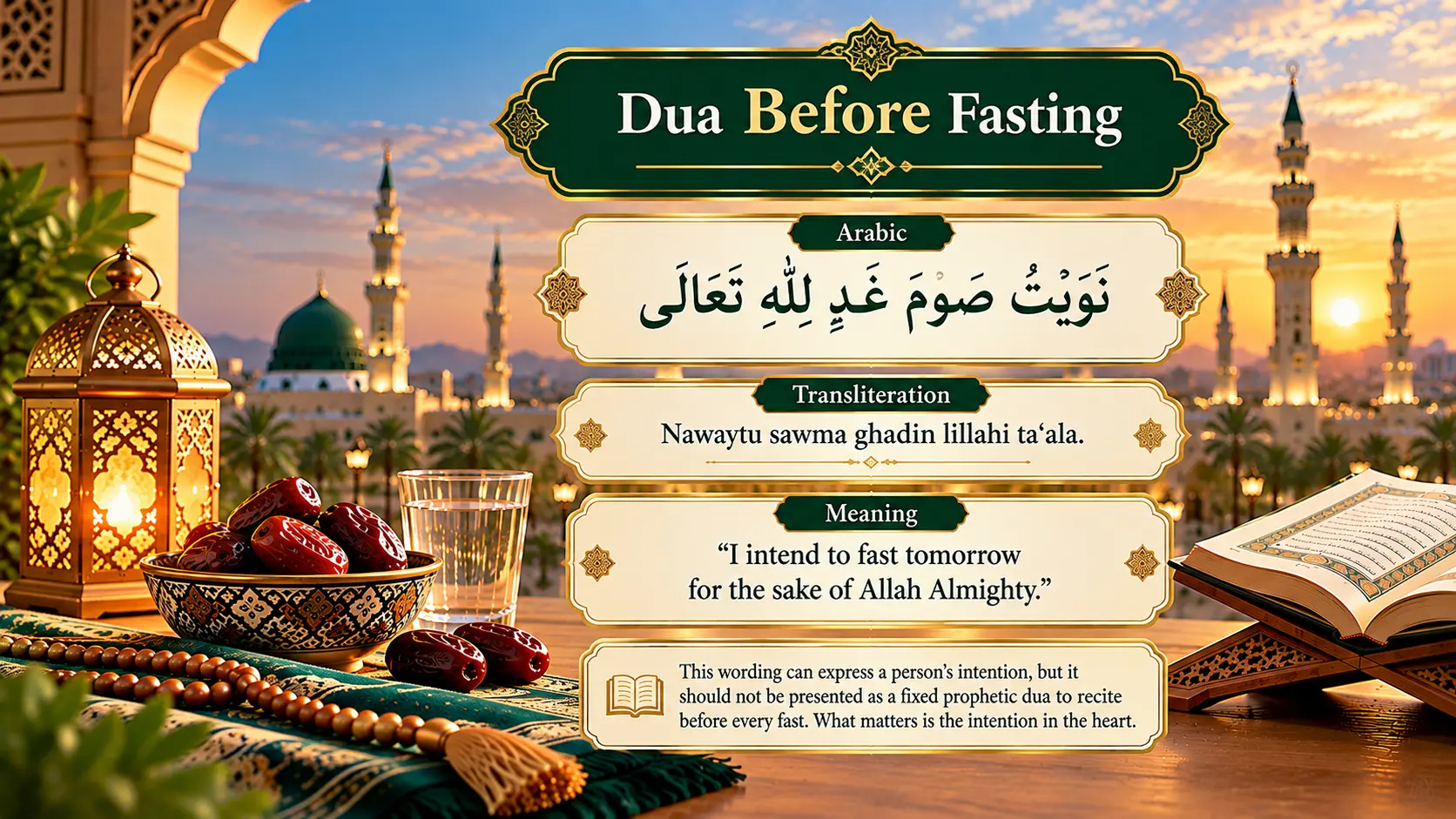
This wording can express a person's intention. Still, it should not be presented as a fixed prophetic dua to recite before every fast. What matters is the intention in the heart.
The detailed rules and wording associated with beginning a fast are covered separately in the dua to close fast guidance.
What Can You Ask Allah for While Fasting?
While fasting, you can make dua for any permissible need. There is no requirement to restrict yourself to one particular "fasting dua."
You may ask Allah for:
forgiveness and mercy;
guidance and steadfastness;
acceptance of your worship;
protection from wrongdoing;
beneficial knowledge and lawful provision;
well-being for yourself, your family, and other Muslims;
goodness in this life and the Hereafter.
One comprehensive Quranic dua that can naturally be made while fasting is:
Arabic:
رَبَّنَا آتِنَا فِي الدُّنْيَا حَسَنَةً وَفِي الْآخِرَةِ حَسَنَةً وَقِنَا عَذَابَ النَّارِ
Transliteration:
Rabbana atina fid-dunya hasanatan wa fil-akhirati hasanatan wa qina ‘adhaban-nar.
English Meaning:
"Our Lord, give us good in this world and good in the Hereafter, and protect us from the punishment of the Fire."
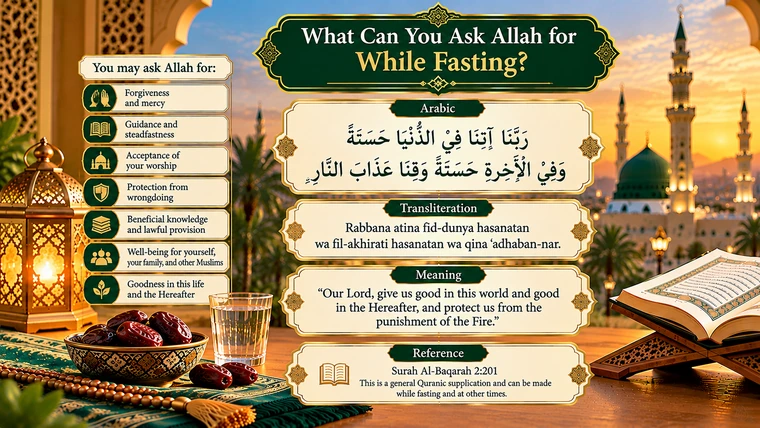
This dua appears in Surah Al-Baqarah 2:201. It is a general Quranic supplication rather than a dua prescribed exclusively for fasting, so it can be made while fasting and at other times.
Dua for Acceptance of Fasting and Worship
A Muslim may ask Allah to accept their fasting and other acts of worship. The Qur’an records the following supplication of Prophet Ibrahim (AS) and Prophet Ismail (AS):
Arabic:
رَبَّنَا تَقَبَّلْ مِنَّا إِنَّكَ أَنْتَ السَّمِيعُ الْعَلِيمُ
Transliteration:
Rabbana taqabbal minna innaka Antas-Sami‘ul-‘Alim.
English Meaning:
"Our Lord, accept from us. Indeed, You are the All-Hearing, the All-Knowing."
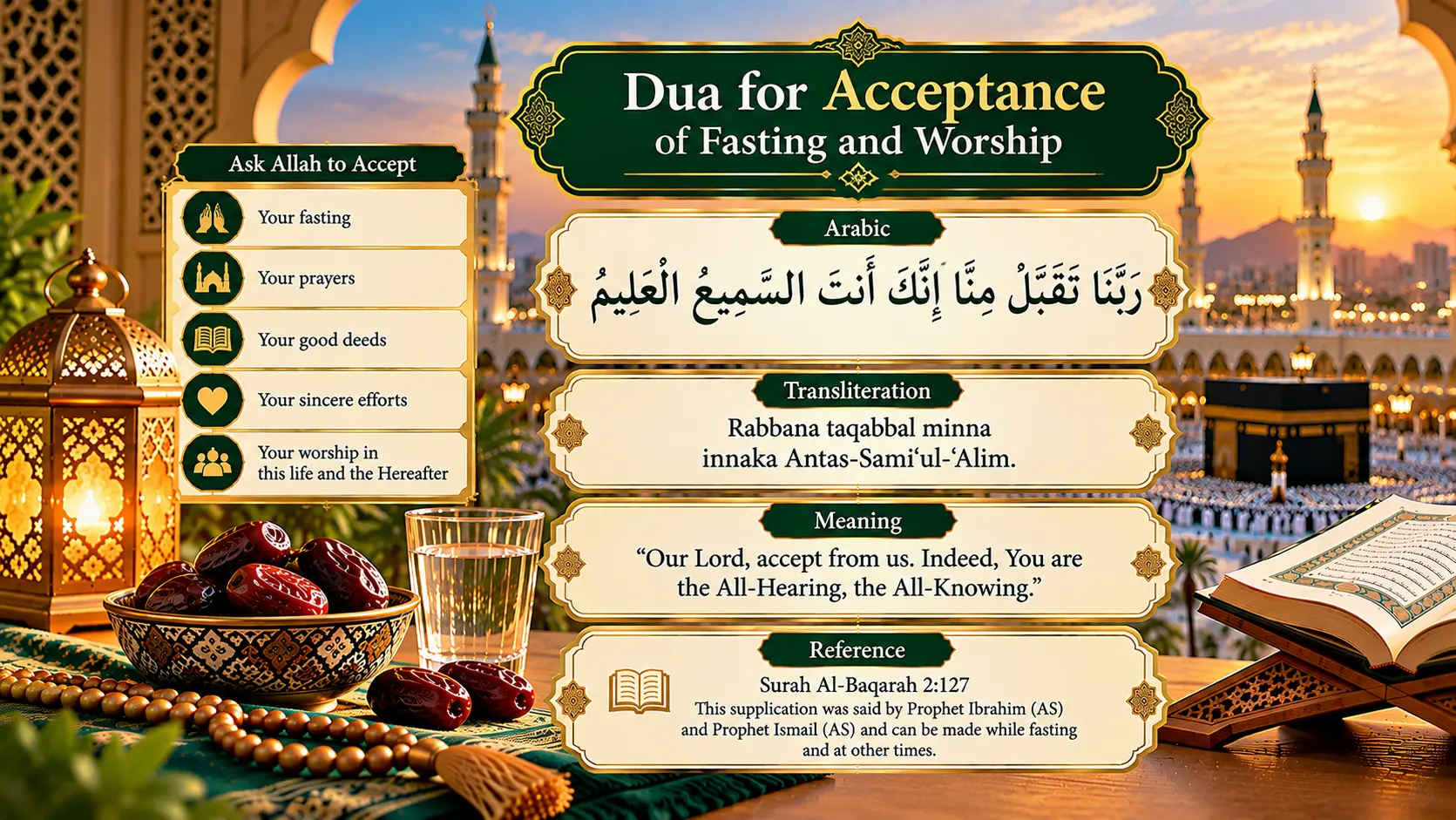
This supplication appears in Surah Al-Baqarah 2:127.
The verse is not specifically a fasting dua; it was said in the context of Ibrahim (AS) and Ismail (AS) raising the foundations of the Ka'bah. However, its general request for Allah to accept an act of worship makes it an appropriate dua for a Muslim seeking acceptance of fasting and other good deeds.
Dua While Fasting
While fasting, you can make dua for forgiveness, guidance, acceptance, protection, family, lawful provision, and any other permissible need. You don't need to repeat a single fixed dua throughout the fasting hours.
A comprehensive dua for forgiveness is:
Arabic:
رَبَّنَا ظَلَمْنَا أَنْفُسَنَا وَإِنْ لَمْ تَغْفِرْ لَنَا وَتَرْحَمْنَا لَنَكُونَنَّ مِنَ الْخَاسِرِينَ
Transliteration:
Rabbana zalamna anfusana wa illam taghfir lana wa tarhamna lanakunanna minal-khasirin.
English Meaning:
"Our Lord, we have wronged ourselves. If You do not forgive us and have mercy upon us, we will surely be among the losers."

This dua appears in Surah Al-A'raf 7:23. It is not prescribed specifically for fasting. Still, its request for Allah's forgiveness and mercy makes it appropriate to recite while fasting.
Dua of a Fasting Person
The dua of a fasting person has a special status in Islamic teachings. The Prophet Muhammad ﷺ said that three supplications are not rejected, including the supplication of the fasting person until they break their fast.
This is reported in Jami' at-Tirmidhi 3598, where the narration is graded as Hasan.
This does not mean that a fasting person must recite one particular Arabic formula. Rather, the fasting period is an opportunity to make sincere dua to Allah for permissible needs.
For guidance and steadfastness, you may recite:
Arabic:
رَبَّنَا لَا تُزِغْ قُلُوبَنَا بَعْدَ إِذْ هَدَيْتَنَا وَهَبْ لَنَا مِنْ لَدُنْكَ رَحْمَةً إِنَّكَ أَنْتَ الْوَهَّابُ
Transliteration:
Rabbana la tuzigh qulubana ba'da idh hadaytana wa hab lana min ladunka rahmatan innaka Antal-Wahhab.
English Meaning:
"Our Lord, do not let our hearts deviate after You have guided us, and grant us mercy from Yourself. Indeed, You are the Bestower."
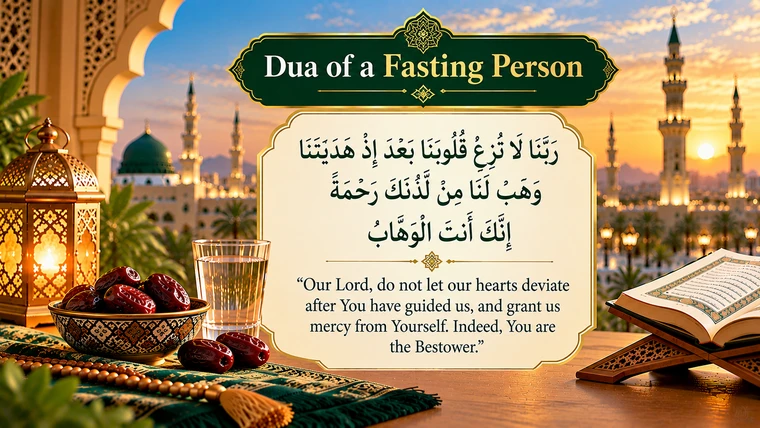
This supplication is found in Surah Ali 'Imran 3:8. It is a general Quranic dua and is not exclusive to fasting.
When Is the Best Time to Make Dua While Fasting?
A fasting person can make dua throughout the fasting period. You do not have to wait until the final minutes before Iftar to ask Allah for something.
The hadith about the fasting person's supplication mentions making dua until they break their fast, supporting dua throughout the fast.
The time approaching Iftar is also a natural opportunity for sincere dua. Still, it should not lead to delaying the breaking of the fast once sunset occurs.
You can make dua silently or verbally and ask Allah in words you understand.
Dua Before Iftar
Before Iftar, you can make personal duas for any permissible matters that matter to you. You don't need to limit yourself to a specific list of requests.
For forgiveness, a well-known Quranic supplication is:
Arabic:
رَبَّنَا اغْفِرْ لَنَا ذُنُوبَنَا وَإِسْرَافَنَا فِي أَمْرِنَا وَثَبِّتْ أَقْدَامَنَا
Transliteration:
Rabbana-ghfir lana dhunubana wa israfana fi amrina wa thabbit aqdamana.
English Meaning:
"Our Lord, forgive us our sins and our excesses in our affairs, and make our feet firm."

This wording forms part of Surah Ali 'Imran 3:147.
It is a general Quranic supplication rather than a specific formula prescribed only before Iftar.
Dua When Breaking the Fast
When the fasting period ends, the focus changes from dua while fasting to the supplication associated with breaking the fast.
An established wording reported from the Prophet Muhammad ﷺ begins:
Arabic:
ذَهَبَ الظَّمَأُ وَابْتَلَّتِ الْعُرُوقُ وَثَبَتَ الْأَجْرُ إِنْ شَاءَ اللَّهُ
Transliteration:
Dhahaba al-zama'u wabtallatil-'urooqu wa thabatal-ajru in sha' Allah.
English Meaning:
"The thirst has gone, the veins are moistened, and the reward is assured, if Allah wills."
It is reported in Sunan Abi Dawud 2357.
This supplication is associated specifically with breaking the fast. Its Hadith evidence, timing and English meaning are explained in the dua to open fast guide, rather than repeated in detail here.
Can You Make Dua in English While Fasting?
Yes. Personal dua while fasting does not have to be made only in Arabic. You can ask Allah for permissible things in English or another language you understand.
Arabic becomes particularly important when quoting a specific Quranic or prophetic supplication because you should preserve its original wording accurately. Its translation explains the meaning but should not be presented as the original Arabic wording.
For a simple personal dua, you may ask:
"Allah, forgive me, accept my fast, guide me, and have mercy upon me and my family."
This is an example of a personal supplication, not a quotation attributed to the Prophet Muhammad ﷺ.
The key distinction is between authentically reported duas, Quranic duas, and a person's own permissible supplications. All three can have a place during fasting. Still, personal wording should not be labelled as a fixed prophetic fasting dua without evidence.
Dua for Fasting in Ramadan
There is no separate fixed dua that must be recited throughout a Ramadan fast. Before fasting, a Muslim makes the sincere intention to fast for Allah; during the fasting hours, they may make personal, Quranic, and authentic prophetic duas.
One particularly relevant Quranic dua for Ramadan is:
Arabic:
رَبَّنَا اغْفِرْ لَنَا وَلِإِخْوَانِنَا الَّذِينَ سَبَقُونَا بِالْإِيمَانِ وَلَا تَجْعَلْ فِي قُلُوبِنَا غِلًّا لِلَّذِينَ آمَنُوا رَبَّنَا إِنَّكَ رَءُوفٌ رَحِيمٌ
Transliteration:
Rabbana-ghfir lana wa li-ikhwanina alladhina sabaquna bil-imani wa la taj'al fi qulubina ghillan lilladhina amanu rabbana innaka ra'ufur-rahim.
English Meaning:
"Our Lord, forgive us and our brothers who preceded us in faith, and do not place in our hearts any resentment toward those who believe. Our Lord, You are truly Most Kind, Most Merciful."
This supplication appears in Surah Al-Hashr 59:10. It is not exclusive to Ramadan. Still, its requests for forgiveness, mercy, and purity of heart make it appropriate to recite while fasting.
Dua for Fasting Outside Ramadan
Fasting outside Ramadan does not require a completely different set of duas. A Muslim can make the same Quranic and authentic general supplications while observing a voluntary fast.
A concise Quranic dua for mercy and forgiveness is:
Arabic:
رَبِّ اغْفِرْ وَارْحَمْ وَأَنْتَ خَيْرُ الرَّاحِمِينَ
Transliteration:
Rabbighfir warham wa Anta khayrur-rahimin.
English Meaning:
"My Lord, forgive and have mercy, for You are the best of those who show mercy."
This is found in Surah Al-Mu'minun 23:118.
The supplication is not specifically prescribed for voluntary fasting. Still, a Muslim can naturally make it while fasting, as they may ask Allah for forgiveness and mercy at any appropriate time.
Dua for Sunnah and Voluntary Fasting
There is no evidence that every Sunnah or voluntary fast requires its own special fasting dua. Whether a person is observing a voluntary fast on Monday, Thursday, or another permissible voluntary fast, they may make general duas throughout the day.
For steadfastness in worship, a relevant Quranic supplication is:
Arabic:
رَبِّ اجْعَلْنِي مُقِيمَ الصَّلَاةِ وَمِنْ ذُرِّيَّتِي رَبَّنَا وَتَقَبَّلْ دُعَاءِ
Transliteration:
Rabbij'alni muqimas-salati wa min dhurriyyati rabbana wa taqabbal du'a.
English Meaning:
"My Lord, make me an establisher of prayer, and many from my descendants. Our Lord, accept my supplication."
This appears in Surah Ibrahim 14:40.
Although the verse specifically mentions prayer and acceptance of supplication rather than fasting, you can recite it as a general dua while observing a voluntary fast.
Dua for Fasting on the Day of Arafah
There is no separate fixed dua that must be recited specifically because a person is fasting on the Day of Arafah.
However, the Day of Arafah itself has special significance for dua. The Prophet Muhammad ﷺ said:
Arabic:
خَيْرُ الدُّعَاءِ دُعَاءُ يَوْمِ عَرَفَةَ
Transliteration:
Khayrud-du'a'i du'a'u yawmi 'Arafah.
English Meaning:
"The best supplication is the supplication on the Day of Arafah."
This is reported in Jami' at-Tirmidhi 3585.
The hadith continues with a declaration of Allah's oneness:
Arabic:
لَا إِلَهَ إِلَّا اللَّهُ وَحْدَهُ لَا شَرِيكَ لَهُ لَهُ الْمُلْكُ وَلَهُ الْحَمْدُ وَهُوَ عَلَى كُلِّ شَيْءٍ قَدِيرٌ
Transliteration:
La ilaha illallahu wahdahu la sharika lah, lahul-mulku wa lahul-hamdu wa Huwa 'ala kulli shay'in qadir.
English Meaning:
"There is no god but Allah alone, without partner. To Him belongs all sovereignty and praise, and He has power over all things."
This should be understood as a virtue connected with the Day of Arafah, rather than as a special formula required to make an Arafah fast valid.
Dua for Fasting on Ashura
There is no separate prophetic dua that must be recited specifically while fasting on Ashura.
A Muslim observing the fast can make general Quranic and authentic supplications throughout the day, just as with other voluntary fasts.
For forgiveness, a short Quranic dua is:
Arabic:
رَبَّنَا اغْفِرْ لَنَا وَارْحَمْنَا وَأَنْتَ خَيْرُ الرَّاحِمِينَ
Transliteration:
Rabbana-ghfir lana warhamna wa Anta khayrur-rahimin.
English Meaning:
"Our Lord, forgive us and have mercy upon us, and You are the best of those who show mercy."
This wording appears in Surah Al-Mu'minun 23:109.
It is a general Quranic dua, not an Ashura-specific fasting supplication.
Do Different Fasts Require Different Duas?
No. Ramadan, Monday and Thursday fasting, Arafah, Ashura, and other voluntary fasts do not each require a different fixed dua to be recited throughout the fast.
What may differ are the rulings, virtues, intention, and occasion associated with each fast. You may still make general Quranic and authentic prophetic duas while fasting.
Similarly, do not confuse the intention made before beginning a fast and the supplication associated with breaking it with general duas made during fasting. Keeping these matters separate helps avoid attributing specific formulas to particular fasts without reliable evidence.
Fasting Dua: What to Remember
A dua for fasting is not one mandatory sentence recited throughout every fast. Instead, understand fasting in its proper stages: make a sincere intention before beginning the fast, make permissible duas to Allah while fasting, and follow the established Sunnah when it is time to break the fast.
You can make Quranic duas for forgiveness, mercy, guidance, and acceptance while fasting. Still, they should not be labelled as fasting-specific formulas unless reliable evidence establishes them as such.
The same principle applies whether you are fasting in Ramadan or observing a voluntary fast. The occasion may change, but you do not need to invent or memorize a different dua for every type of fast.