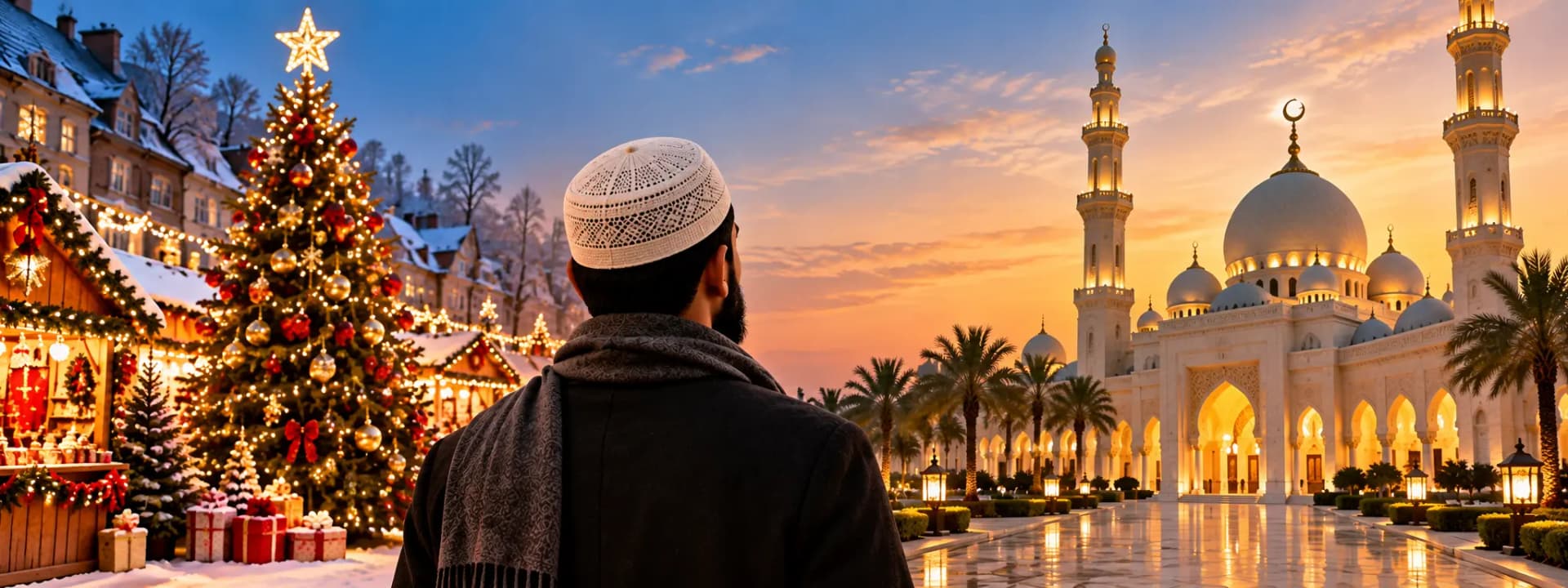
Muslims generally do not celebrate Christmas as a religious festival because it is not part of Islamic worship or the Islamic calendar. Islam honours Jesus (Isa) as the Messiah and a messenger of Allah, but does not accept the Christian belief that Jesus is divine or the son of God. For this reason, Muslims do not celebrate Christmas. Muslims instead have two main religious festivals: Eid al-Fitr and Eid al-Adha. Questions about saying "Merry Christmas," exchanging gifts, attending Christmas meals or parties, and using Christmas decorations involve further considerations. Muslim scholars may distinguish between religious participation and ordinary social courtesy.
Do Muslims Celebrate Christmas?
No, Muslims do not traditionally celebrate Christmas as an Islamic religious festival. Christmas commemorates the birth of Jesus Christ within Christianity, while Islamic religious celebrations are based on Islamic teachings and traditions.
This does not mean that Muslims reject Jesus. In Islam, Jesus is known as Isa ibn Maryam (Jesus, son of Mary) and is honoured as the Messiah and one of Allah's messengers. The Qur'an states:
"The Messiah, Jesus, son of Mary, was no more than a messenger of Allah…"
Qur'an 4:171
The same verse teaches that Allah is One and rejects describing Him as part of a Trinity or as having a son.
Therefore, Muslims can deeply respect Jesus while not observing Christmas as a religious occasion.
Why Don't Muslims Celebrate Christmas?
Muslims generally do not celebrate Christmas because Christmas is not prescribed as an Islamic religious festival, and some of the theological beliefs traditionally associated with Christmas differ from Islamic teachings about Allah and Jesus.
The main distinction is belief, not a lack of respect for Christianity or Christians.
Islam teaches that:
Allah is One.
Jesus (Isa) is the Messiah and a messenger of Allah.
Mary (Maryam) holds an honoured position in Islam.
Jesus was born miraculously to Mary.
Muslims are required to believe in Jesus as one of Allah's messengers.
Islam does not teach that Jesus is God or the son of God.
The Qur'an directly describes Jesus as the Messiah and messenger of Allah while affirming the absolute oneness of God in Surah An-Nisa 4:171.
Because Christmas is a Christian religious observance rather than an Islamic one, Muslims have their own religious festivals instead of adopting Christmas as an Islamic celebration.
What Do Muslims Believe About Jesus?
Muslims believe that Jesus (Isa) was the Messiah, a prophet and messenger of Allah who was miraculously born to Mary (Maryam). Belief in Jesus is part of Islamic faith, but Islam does not regard him as divine.
The Qur'an gives both Jesus and Mary an important place in Islamic belief. Mary is also the only woman named explicitly in the Qur'an, and Surah Maryam (Chapter 19) is named after her.
A key difference between Islamic and mainstream Christian theology concerns Jesus's nature.
Belief | Islamic Teaching |
Jesus is the Messiah | Yes |
Jesus is a messenger of Allah | Yes |
Jesus was born to Mary | Yes |
His birth was miraculous | Yes |
Muslims should believe in Jesus | Yes |
Jesus is God | No |
Jesus is the son of God | No |
God is part of a Trinity | No |
These differences explain why believing in and honouring Jesus in Islam does not mean that Muslims observe Christmas.
Can Muslims Celebrate Christmas?
Christmas is not an Islamic religious celebration, so Muslims do not observe it as part of Islamic worship. However, what counts as "celebrating Christmas" can vary, from taking part in religious ceremonies to attending a workplace meal or exchanging a gift with a neighbour.
These situations should not automatically be treated as identical.
Participating in explicitly religious worship differs from everyday interaction with Christian relatives, neighbours, colleagues, or friends. Islamic guidance also emphasises maintaining good conduct, justice, and kindness toward people of other faiths.
For that reason, practical questions about Christmas are better considered by the activity's nature and purpose than by assuming every interaction during the Christmas period carries the same meaning.
This distinction becomes particularly relevant for Muslims living in countries such as the United Kingdom, where Christmas is also a major public and cultural holiday.
Do Some Muslims Celebrate Christmas?
Yes, some Muslims may take part in Christmas related social or cultural activities, especially in multicultural families, workplaces or countries where Christmas is widely observed. This does not make Christmas an Islamic religious festival.
Individual behaviour and Islamic religious teaching are not always the same thing.
A Muslim might, for example, spend time with non-Muslim relatives during the holiday period or attend a workplace gathering without personally regarding Christmas as a religious celebration.
Similarly, British, American, Pakistani, Arab, Turkish or other Muslim communities are not religiously defined by whether people around them celebrate Christmas. Cultural practices can vary between individuals, families and countries.
The more useful question is therefore not simply whether some Muslims participate, but what type of participation is involved and whether it has a religious, cultural or social meaning.
Is Christmas Haram for Muslims?
Christmas itself is a Christian festival, not an Islamic one. Muslim scholars generally distinguish between adopting another religion's worship or religious beliefs and ordinary social dealings with non-Muslims.
As a result, a single word such as "Christmas" does not describe every possible situation. Attending a religious service, displaying a religious symbol, sharing a meal with relatives, accepting a gift and being polite to a colleague are different actions and may require different considerations.
For Muslims trying to make a personal religious decision, the relevant questions include:
Does the activity involve another religion's worship or religious beliefs?
Is the action intended as religious observance?
Is it instead an ordinary social, family or workplace interaction?
Does it involve anything independently prohibited in Islam?
Is there a recognised difference of scholarly opinion on the specific issue?
This distinction matters when considering common questions about Christmas greetings, gifts, trees, decorations, parties, and meals. These practical situations are addressed separately rather than treating every Christmas-related activity as the same religious act.
Christmas and Muslim Religious Festivals
Christmas has no direct Islamic equivalent. Muslims have their own religious festivals, with Eid al-Fitr and Eid al-Adha being the two principal annual Eids.
Eid al-Fitr comes at the end of Ramadan, while Eid al-Adha takes place during Dhul-Hijjah and is closely connected with the period of Hajj.
Although people sometimes describe Eid as the "Muslim Christmas" to make a simple cultural comparison, this is not an accurate religious description. Eid and Christmas have different origins, beliefs, practices and meanings.
For example, Eid al-Adha falls on 10 Dhul-Hijjah and forms part of the wider Hajj season. Muslims commonly exchange greetings and good wishes during Eid, including the messages shared for Eid al-Adha, while Eid al-Fitr marks the completion of Ramadan and has its own Eid greetings and wishes.
The two Eids should therefore be understood on their own Islamic terms rather than as Islamic versions of Christmas.
Can Muslims Say Merry Christmas?
There is a difference of scholarly opinion on whether Muslims should say "Merry Christmas" to Christians.
Some scholars advise Muslims not to use greetings specifically associated with another religion's festival, particularly where the wording could be understood as approving religious beliefs that Islam does not share. Other contemporary scholars permit courteous Christmas greetings when they are intended as kindness and good relations rather than an endorsement of Christian theology.
This distinction is important in workplaces, schools, neighbourhoods and families where Muslims and Christians regularly interact.
A Muslim following a more cautious view may use neutral expressions such as "Best wishes," "Enjoy your holiday," or "Wishing you and your family well."
The intention, wording and context should therefore be considered rather than assuming that every Christmas greeting has the same religious meaning.
Can Muslims Give or Accept Christmas Gifts?
Giving or accepting a gift is not automatically the same as participating in religious worship. However, scholars may distinguish between an ordinary gift exchanged as a gesture of kindness and a gift intended to participate in or promote a religious observance.
Islam encourages good relations and fair treatment towards people who live peacefully with Muslims. The Qur'an states that Allah does not forbid Muslims from dealing kindly and justly with those who do not fight them because of their religion (Qur'an 60:8).
For this reason, the gift's purpose and nature matter. A general gift from a colleague, neighbour, friend or relative may be viewed differently from something directly connected with religious worship or containing something prohibited in Islam.
The same principle applies when a Muslim gives a gift: social courtesy and maintaining family relationships should be distinguished from adopting another faith's religious practices.
Can Muslims Have a Christmas Tree or Christmas Decorations?
A Christmas tree is widely associated with Christmas, so Muslims who avoid participating in the festival generally do not put up a Christmas tree as part of their own religious or festive observance.
The same consideration applies to decorations that clearly function as symbols of Christmas celebration.
However, there is a useful distinction between specifically Christmas-related decorations and ordinary seasonal decoration. Lights, winter colours or general decorations do not necessarily have the same meaning in every setting.
The relevant question is whether the item is being used to identify with or celebrate Christmas, or whether it has an ordinary non-religious purpose unrelated to the festival.
Can Muslims Attend Christmas Parties?
Attendance depends on the event's nature.
A Christmas religious service is different from an end-of-year workplace meal or a family gathering held during the Christmas holiday period. Muslims should consider the event's activities rather than relying only on its name.
A social gathering may need to be avoided if it involves activities prohibited in Islam, such as alcohol consumption or conduct inconsistent with Islamic principles. This applies whether the event takes place at Christmas or another time of year.
Islam prohibits intoxicants. The Qur'an instructs believers to avoid intoxicants and gambling in Surah Al-Ma'idah 5:90.
For Muslims in workplaces or mixed-faith families, the key distinction is between maintaining respectful social relationships and personally participating in religious worship or prohibited activities.
Can Muslims Eat Christmas Dinner or Christmas Food?
There is no separate Islamic category of food simply because it is served during the Christmas period. What matters for a Muslim is whether the food itself is halal and whether eating it involves participation in a religious act.
A meal with family, friends, or colleagues should therefore be assessed by its ingredients, preparation, and context.
Muslims should avoid pork, intoxicants and other prohibited food or drink. Meat should also meet the halal requirements the individual follows.
Foods such as vegetables, bread, desserts or other permissible dishes do not become haram merely because they are eaten in December or served at a Christmas gathering.
Can Muslims Go to Christmas Markets?
Visiting a Christmas market is not necessarily the same as observing Christmas as a religious festival. The purpose of the visit and the activities involved are relevant.
Modern Christmas markets may contain food stalls, shopping, entertainment and seasonal attractions alongside Christmas imagery and traditions. A Muslim visiting such a market for shopping or spending time with family is in a different situation from someone participating in religious worship.
Normal Islamic rules still apply. Muslims should avoid prohibited food, alcohol and activities that conflict with their religious principles.
This distinction also helps separate ordinary visits to public seasonal events from sensational claims that Muslims as a group either oppose or seek to disrupt Christmas celebrations. Such claims should be judged on reliable evidence rather than assumptions about Muslims generally.
Can Muslims Sing Christmas Carols or Listen to Christmas Music?
Christmas songs are not all the same. Some are explicitly religious and contain statements of Christian belief, while others are primarily cultural or seasonal.
For Muslims, this difference matters.
Songs that affirm theological beliefs contrary to Islam raise a different religious issue from ordinary seasonal music playing in a shop, workplace or public space. Actively singing religious lyrics is also different from simply hearing background music in everyday life.
Muslims seeking a personal ruling on a particular activity should consider the lyrics, intention and context rather than treating every piece of Christmas-related music as identical.
Can Muslims Wear Christmas Jumpers or Christmas Clothes?
The design and meaning of the clothing matter.
Ordinary winter clothing or clothing with neutral seasonal designs is not necessarily religious. Clothing specifically displaying religious statements or symbols, however, raises a different question for a Muslim.
Christmas jumpers can range from simple snowflakes and winter patterns to explicit religious imagery. It is therefore more accurate to consider what the clothing represents than to give every item labelled "Christmas clothing" the same ruling.
The same principle applies to workplace Christmas jumper days: consider the specific design, purpose, and circumstances.
Do Muslims Celebrate Christmas in the UK?
Christmas is not an Islamic festival for British Muslims. Still, Muslims in the UK experience the Christmas period in many different ways because it is also a major national holiday and part of public life.
Some Muslims work on Christmas Day, while others have the day off. Some spend time with family or non-Muslim relatives, attend social gatherings or take part in ordinary seasonal activities. Others choose to avoid Christmas-related activities altogether.
These differences in personal behaviour do not change Christmas's religious status in Islam.
British Muslims may also use the holiday period for family time, community work, volunteering or rest. There is therefore no single cultural answer describing what every Muslim in the UK does at Christmas.
What Can Muslims Do on Christmas Day?
For Muslims, Christmas Day does not require any special Islamic worship or celebration. They can treat it as an ordinary day while maintaining respectful relationships with people who observe the festival.
Depending on individual circumstances, Muslims may:
spend time with family;
visit relatives or friends;
rest if they have a public holiday;
help neighbours or people in need;
volunteer or support community initiatives;
eat permissible food with family or friends;
continue their normal prayers and daily activities.
Acts of kindness do not need to become religious participation. Muslims can maintain their Islamic beliefs while treating Christian neighbours, colleagues and relatives with courtesy and respect.
This balance between religious identity and good conduct is particularly relevant for Muslims living in religiously diverse societies.
Is Eid the Muslim Equivalent of Christmas?
No. Eid is sometimes informally compared with Christmas because both can involve family gatherings, special meals, gifts and community celebrations, but they are religiously different occasions.
Islam has two annual Eids: Eid al-Fitr and Eid al-Adha. Eid al-Fitr marks the completion of Ramadan, while Eid al-Adha takes place on 10 Dhul-Hijjah during the Hajj season and commemorates devotion and obedience to Allah.
Calling Eid "Muslim Christmas" may help someone make a simple cultural comparison, but it does not accurately reflect its religious meaning.
Is Ramadan Like Christmas for Muslims?
No. Ramadan is a month of fasting and worship, whereas Christmas is a Christian festival. They have different religious foundations and should not be treated as equivalents.
During Ramadan, non-disabled adult Muslims abstain from food and drink from dawn until sunset. The month also emphasises prayer, Qur'an recitation, charity, and spiritual discipline.
Ramadan ends with Eid al-Fitr, which is a celebration. Ramadan itself is therefore not the Islamic version of Christmas.
Do Muslims Believe Jesus Was Born on Christmas Day?
Muslims believe in the miraculous birth of Jesus (Isa) to Mary (Maryam), but the Qur'an does not specify 25 December as the date of his birth.
Surah Maryam describes Mary withdrawing from her family, the birth of Jesus and the events surrounding it, but it does not provide a calendar date for the birth.
Muslims therefore do not have an Islamic religious requirement to observe 25 December as Jesus's birthday.
Do Muslims Celebrate Christmas Eve?
Christmas Eve has no prescribed religious observance in Islam. Muslims who follow Islamic religious festivals do not have a special act of worship or celebration required for 24 December.
Individual Muslims may still attend family or social gatherings on that date, particularly in mixed-faith families or societies where Christmas is widely observed. Such personal participation should not be confused with an Islamic religious observance.
Do Sunni and Shia Muslims Celebrate Christmas?
Christmas is not a principal religious festival in either Sunni or Shia Islam. Muslims from both traditions recognise Jesus as an important figure in Islam, but Christmas remains a Christian festival.
Individual Sunni or Shia Muslims may differ in how they approach social activities during the Christmas period. Those individual choices should not be used to define the religious practices of an entire Muslim community.
Do Muslims Celebrate Christmas and New Year?
Christmas and New Year are separate occasions and should not be treated as one religious question.
Christmas is a Christian festival associated with the birth of Jesus Christ. The Gregorian New Year begins on 1 January.
Islam also has the Hijri calendar, whose year begins with Muharram. However, the Hijri year does not begin with one of Islam's two Eids.
A Muslim's approach to New Year activities may therefore depend on what the event involves rather than on Islamic rulings about Christmas.
Are Muslims Offended by Christmas?
Muslims should not be described collectively as being offended by Christmas. Muslims are a diverse global population, and individual attitudes towards public Christmas celebrations vary.
A Muslim choosing not to celebrate Christmas does not necessarily object to Christians celebrating it.
Claims that Christmas celebrations, lights or markets have been cancelled simply because they "offend Muslims" should be checked against reliable evidence before being repeated. Viral posts, headlines and social-media claims do not establish what Muslims generally believe.
Respect can work in both directions: Muslims can maintain their own religious beliefs while recognising that Christians have their own religious traditions.
Do Muslims Have a Holiday Around Christmas?
Islam does not have a religious holiday tied to 25 December. Islamic occasions follow the Hijri lunar calendar, so their Gregorian dates shift each year.
In countries such as the United Kingdom, Muslims may still receive Christmas Day and other Christmas-period days off because they are public or workplace holidays. However, having a day off does not make Christmas an Islamic festival.
Christmas and Islam: What Muslims Should Keep in Mind
Muslims generally do not celebrate Christmas as a religious festival because it is not part of Islamic worship, even though Islam deeply honours Jesus (Isa) and his mother Mary (Maryam). Muslims believe Jesus is the Messiah and a messenger of Allah, but not God or the son of God.
Christmas-related situations are not all identical. Religious worship, social gatherings, greetings, gifts, food, decorations and workplace activities can involve different considerations, which is why context and intention matter.
Muslims have their own religious festivals, Eid al-Fitr and Eid al-Adha, and neither Eid nor Ramadan is simply an Islamic version of Christmas. Muslims can maintain these religious distinctions while treating Christian relatives, neighbours, colleagues and communities with kindness, fairness and respect.