
The dua before eating in Islam is بِسْمِ اللَّهِ (Bismillah), meaning "In the name of Allah." Prophet Muhammad (peace be upon him) taught Muslims to mention Allah's name before eating, making this short phrase an important part of Islamic mealtime etiquette. You can recite it before breakfast, lunch, dinner, or any other meal.
Download Dua Before Eating PDF
If you forget to say Bismillah before starting your food, the Sunnah provides another supplication to recite when you remember. This guide explains the dua before eating in Arabic, its English transliteration and meaning, authentic Hadith references, and how to practise this Sunnah in everyday life.
What Is the Dua Before Eating in Islam?
The dua before eating is Bismillah, which means "In the name of Allah." Prophet Muhammad (peace be upon him) taught this established wording, and authentic Hadith support it.
Dua Before Eating in Arabic
بِسْمِ اللَّهِ
English Transliteration
Bismillah
English Translation
"In the name of Allah."

Muslims say these words before taking their first bite of food. The supplication is short enough for children to memorise and can be used before meals at home, school, work or while travelling.
You do not need to recite a lengthy Arabic supplication to fulfil this particular Sunnah. Saying Bismillah is sufficient.
Authentic Hadith About Dua Before Eating
The clearest evidence for saying Bismillah before eating comes from the authentic Hadith of Umar ibn Abi Salamah (may Allah be pleased with him).
He narrated that Prophet Muhammad (peace be upon him) said to him:
"O boy, mention the Name of Allah, eat with your right hand, and eat from what is nearest to you."
Hadith references: Sahih al-Bukhari 5376 and Sahih Muslim 2022.
This Hadith establishes three important aspects of Islamic eating etiquette:
Mention Allah's name before eating.
Eat with your right hand.
Eat from the food nearest to you when sharing a common dish.
The Prophet's instruction was given to a young boy, showing that these manners can be taught from an early age.
The Hadith also demonstrates that remembering Allah before eating does not require complicated wording. A short phrase can become a consistent part of daily worship.
What Does Bismillah Mean Before Eating?
Bismillah means "In the name of Allah." Saying it before eating expresses remembrance of Allah and acknowledges that food and nourishment are among His blessings.
The Arabic phrase consists of two elements:
Arabic | Transliteration | Meaning |
بِسْمِ | Bismi | In the name of |
اللَّهِ | Allah | Allah (God) |
By saying Bismillah, Muslims begin their meals with the remembrance of Allah rather than treating eating as an activity disconnected from faith.
The Quran also reminds believers to appreciate the food Allah provides:
"So eat of the lawful and good food which Allah has provided for you, and be grateful for the favour of Allah."
Quran reference: Surah An-Nahl (16:114), English rendering of the meaning.
This verse encourages gratitude for lawful provision. Although it does not prescribe the specific words of the eating dua, it supports the broader Islamic principle of remembering Allah and appreciating His blessings.
Is There a Longer Dua Before Eating?
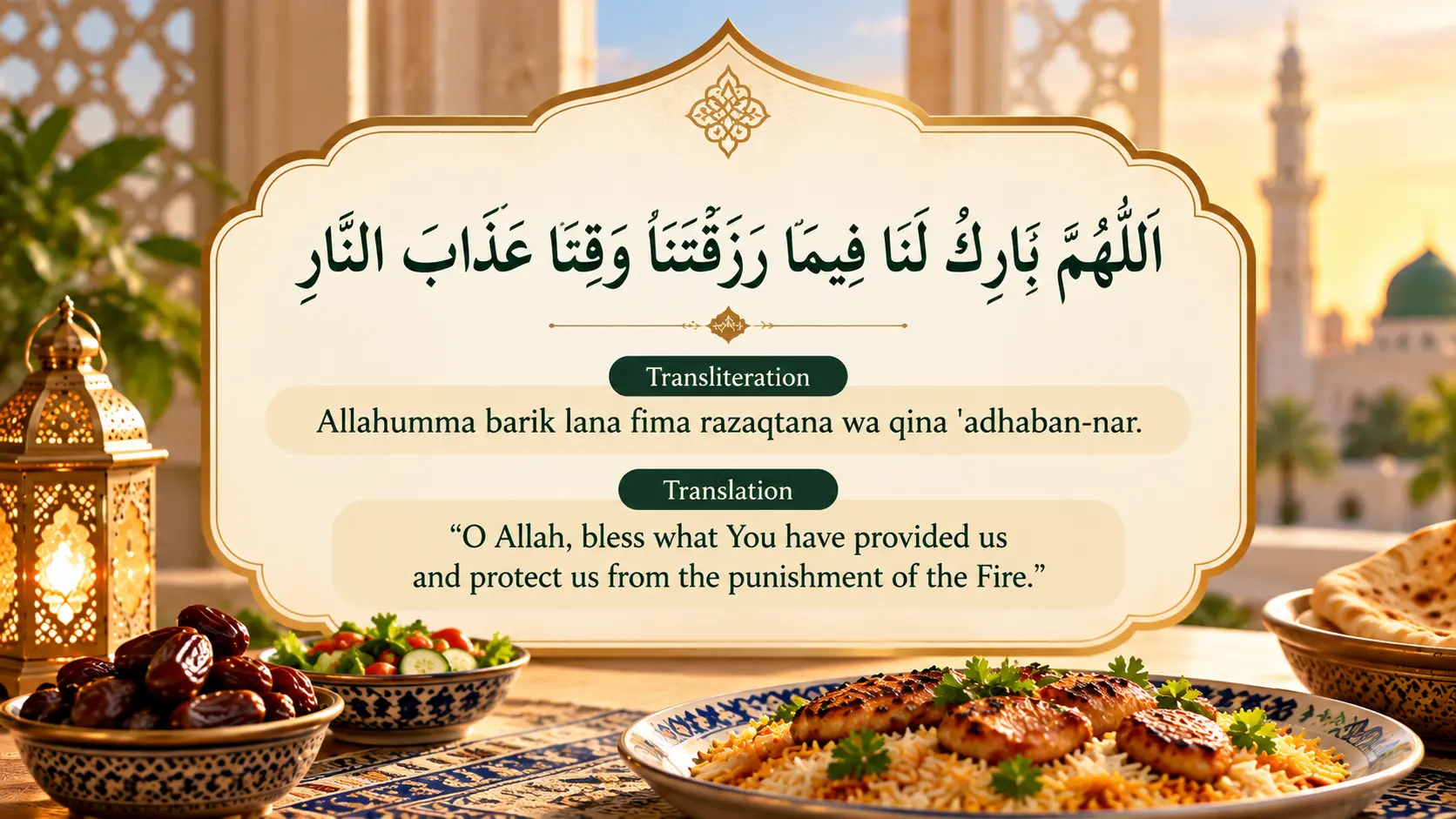
Some Muslims learn a longer supplication beginning with Allahumma barik lana fima razaqtana, asking Allah to bless the food He has provided.
Longer Dua Before Eating in Arabic
اللَّهُمَّ بَارِكْ لَنَا فِيمَا رَزَقْتَنَا وَقِنَا عَذَابَ النَّارِ
English Transliteration
Allahumma barik lana fima razaqtana wa qina 'adhaban-nar.
English Translation
"O Allah, bless what You have provided us and protect us from the punishment of the Fire."
Is This Longer Dua Authentic?
This wording is widely taught in some Muslim communities. However, narrations specifically attributing it to Prophet Muhammad (peace be upon him) as a regular supplication before eating have been graded weak by Hadith scholars.
It is important to distinguish between a general supplication with a permissible meaning and a particular wording reliably established as the Prophet's Sunnah.
For Muslims looking for an authentically established dua before eating, بِسْمِ اللَّهِ (Bismillah) remains the clearest recommendation.
A Muslim may also ask Allah to bless their food using their own words, without claiming that a particular formula is an established Prophetic practice.
Why Is Saying Bismillah Before Eating Important?
Saying Bismillah before eating matters because it follows the guidance of Prophet Muhammad (peace be upon him), encourages remembrance of Allah, and helps Muslims approach everyday meals with gratitude.
Following the Sunnah
The Prophet explicitly instructed Muslims to mention Allah's name when eating, as recorded in Sahih al-Bukhari 5376.
This makes Bismillah a practical Sunnah to follow every day, regardless of the type of meal or where it is eaten.
Remembering Allah's Blessings
Food is a daily necessity, but Islam encourages believers not to overlook its value.
Beginning with Bismillah reminds Muslims that their nourishment is part of Allah's provision. It also encourages gratitude toward food.
Preventing Shaytan From Sharing in the Meal
An authentic narration in Sahih Muslim explains that when a person mentions Allah's name upon entering their home and beginning to eat, Shaytan is prevented from finding lodging and food there.
Hadith reference: Sahih Muslim 2018.
This narration highlights the spiritual significance of remembering Allah before a meal.
When Should You Say the Dua Before Eating?
Muslims should say Bismillah before taking the first bite of food. This applies to ordinary meals, snacks and other occasions when eating.
Examples include:
Breakfast, lunch and dinner
Snacks and light meals
Eating fruit, dates or other permissible foods
Meals at restaurants or another person's house
Suhoor and iftar during Ramadan
The same short remembrance suits different types of food. You don't need to memorise a separate opening dua for every meal.
If someone forgets Bismillah and begins eating, the Sunnah provides specific wording to recite when they remember. The next section of this guide covers that supplication.
What If You Forget to Say Bismillah Before Eating?
If you forget to say Bismillah before eating, Islam teaches a specific supplication to recite as soon as you remember. You can say it even if you have already started your meal.
Dua When You Forget Bismillah in Arabic
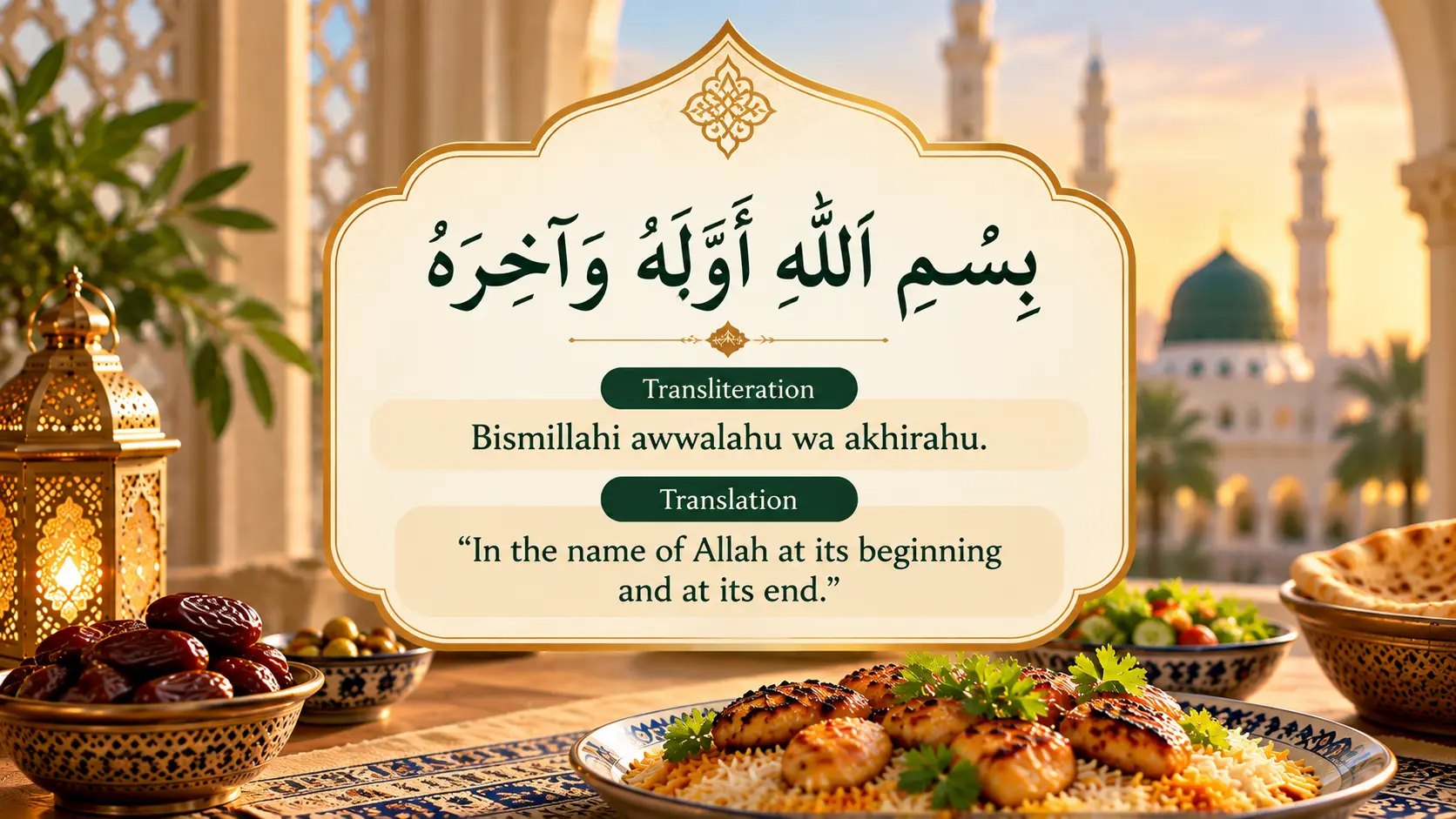
بِسْمِ اللَّهِ أَوَّلَهُ وَآخِرَهُ
English Transliteration
Bismillahi awwalahu wa akhirahu.
English Translation
"In the name of Allah at its beginning and at its end."
Authentic Hadith Reference
Aisha (may Allah be pleased with her) narrated that Prophet Muhammad (peace be upon him) instructed Muslims to mention Allah's name when eating. He also taught the above supplication for anyone who forgets at the beginning.
Source: Sunan Abi Dawud 3767, graded Sahih by Al-Albani.
This supplication applies when someone forgets Bismillah, whether they remember shortly after beginning or later during the meal.
Is There a Dua to Recite in the Middle of Eating?
There is no separate, universally prescribed supplication that Muslims must recite halfway through every meal. However, if someone realises they forgot Bismillah at the beginning, they should recite the supplication taught for that situation.
For example, if you remember while eating lunch or dinner, say:
بِسْمِ اللَّهِ أَوَّلَهُ وَآخِرَهُ
Transliteration: Bismillahi awwalahu wa akhirahu.
Meaning: "In the name of Allah at its beginning and at its end."
You do not need to restart your meal or repeat the supplication for every remaining bite.
If you already mentioned Allah's name before eating, you don't need to recite another specific dua in the middle of the meal.
Sunnah Eating Etiquette in Islam
Islamic eating etiquette includes remembering Allah, using the right hand, eating considerately and avoiding unnecessary waste. These manners are rooted in the Quran and the teachings of Prophet Muhammad (peace be upon him).
Eat With Your Right Hand
Prophet Muhammad (peace be upon him) instructed Muslims to eat with their right hand.
Hadith reference: Sahih Muslim 2020.
This is an established part of Islamic eating etiquette. However, someone who cannot use their right hand because of an injury, disability or another genuine difficulty should not be treated as deliberately disregarding the Sunnah.
Eat From the Food Nearest to You
When sharing a common dish, Muslims are encouraged to take food from the portion nearest to them.
The Prophet taught this manner to Umar ibn Abi Salamah, as recorded in Sahih al-Bukhari 5376.
This guidance encourages consideration for others, particularly when several people are eating from the same serving dish.
Avoid Criticising Food
Prophet Muhammad (peace be upon him) did not criticise food. If he liked what was served, he ate it; otherwise, he left it.
Hadith reference: Sahih al-Bukhari 5409.
This example encourages appreciation for meals and respect for the people who prepare them.
Avoid Wasting Food
Islam discourages wastefulness, including unnecessary food waste.
The Quran states:
"Eat and drink, but do not be excessive."
Quran reference: Surah Al-A'raf (7:31), English rendering of the meaning.
Taking suitable portions and avoiding unnecessary waste are practical ways to follow this guidance.
Dua When Eating at Someone's House
When eating at someone else's house, Muslims should begin with Bismillah, just as they would at home. They may also make a supplication asking Allah to bless the person who provided the food.
Dua for Someone Who Provides Food
Arabic:
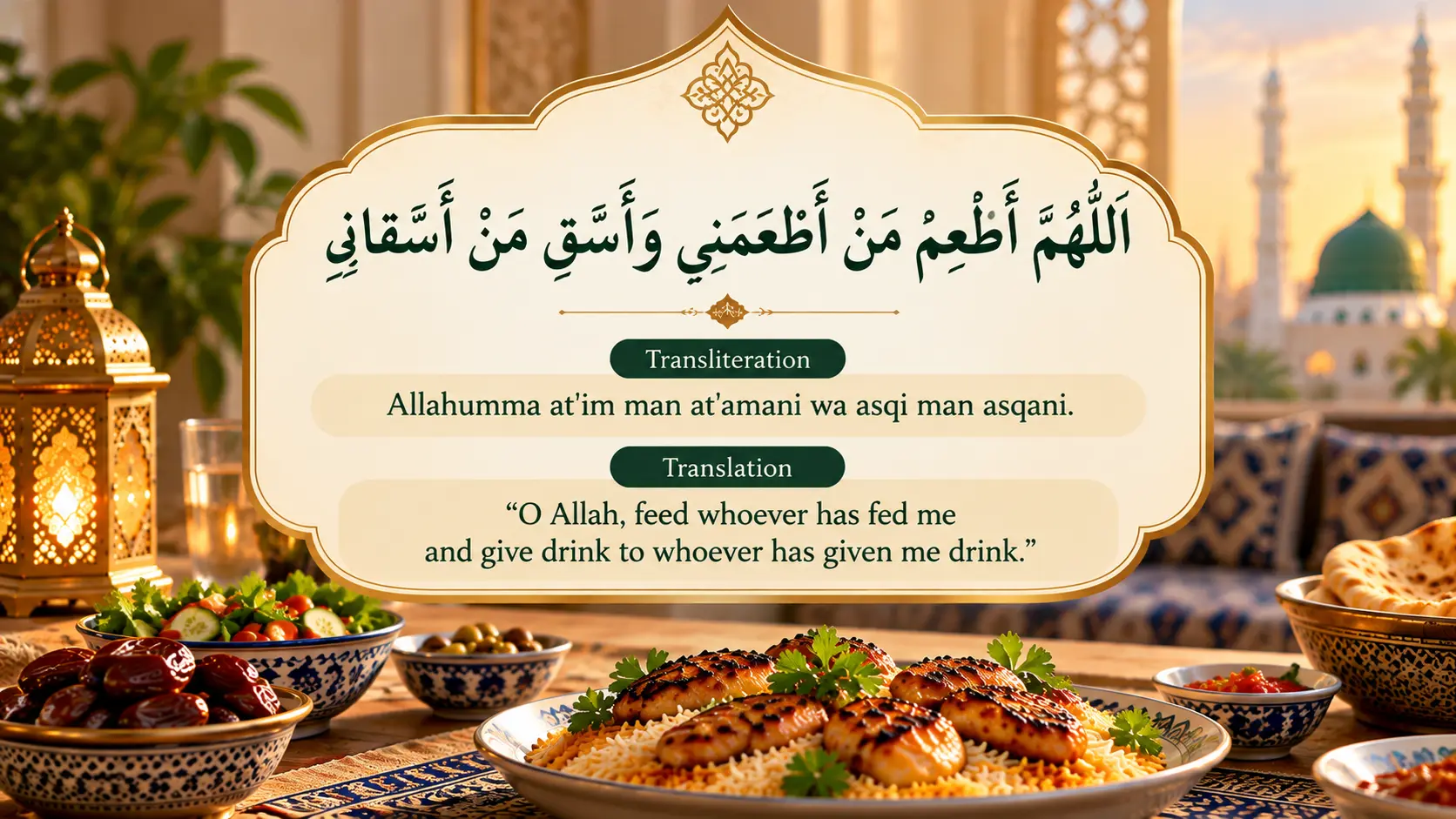
اللَّهُمَّ أَطْعِمْ مَنْ أَطْعَمَنِي وَأَسْقِ مَنْ أَسْقَانِي
English Transliteration:
Allahumma at'im man at'amani wa asqi man asqani.
English Translation:
"O Allah, feed whoever has fed me and give drink to whoever has given me drink."
Hadith reference: Sahih Muslim 2055a.
Prophet Muhammad (peace be upon him) made this supplication. It expresses goodwill and gratitude towards someone who provides food or drink.
Another Supplication for a Host
The Prophet also made the following supplication after being served food:
Arabic:
أَفْطَرَ عِنْدَكُمُ الصَّائِمُونَ وَأَكَلَ طَعَامَكُمُ الْأَبْرَارُ وَصَلَّتْ عَلَيْكُمُ الْمَلَائِكَةُ
English Transliteration:
Aftara 'indakumus-sa'imun, wa akala ta'amakumul-abrar, wa sallat 'alaykumul-mala'ikah.
English Translation:
"May fasting people break their fast with you, may righteous people eat your food, and may the angels invoke blessings upon you."
Hadith reference: Sunan Abi Dawud 3854, graded Sahih by Al-Albani.
This supplication is particularly meaningful when thanking someone for their hospitality, including when they provide food during Ramadan.
Do You Need a Different Dua Before Eating Fruit or Other Foods?
No separate opening dua is required for every type of food. The general Sunnah is to mention Allah's name before eating, whether the meal consists of fruit, dates, rice, bread or other permissible foods.
For example:
Food or situation | What to say before eating |
Fruit or dates | Bismillah |
Breakfast, lunch or dinner | Bismillah |
Snacks | Bismillah |
Food at a restaurant | Bismillah |
Food at someone's house | Bismillah |
The same general principle applies to drinking water and other permissible beverages.
Although additional narrations concern particular foods and occasions, Muslims do not need to memorise a different supplication for every ordinary meal.
What Should You Say After Finishing Your Meal?
After eating, Muslims are encouraged to praise Allah for the food He has provided. This is a separate practice from saying Bismillah before eating.
While Bismillah is recited before a meal, the dua after eating focuses on praising Allah and expressing gratitude for the food He has provided.
The distinction is simple: recite Bismillah before eating, and recite words of praise and gratitude afterwards.
Dua Before Eating for Kids
The dua before eating for kids is بِسْمِ اللَّهِ (Bismillah), meaning "In the name of Allah." It is one of the simplest Islamic phrases children can learn and practise before meals.
Teaching children this short dua helps them develop the habit of remembering Allah while eating. Parents can introduce it through everyday routines without expecting children to memorise lengthy supplications.
How to Teach Children the Dua Before Eating
Start with these three simple elements:
Arabic | Transliteration | English Meaning |
بِسْمِ اللَّهِ | Bismillah | In the name of Allah |
Parents can help children learn by:
Saying Bismillah aloud before family meals.
Encouraging children to repeat the words naturally.
Explaining that food is a blessing from Allah.
Praising their efforts rather than criticising mistakes.
Gradually introducing other Islamic eating manners.
The Prophet Muhammad (peace be upon him) taught Umar ibn Abi Salamah to remember Allah and observe good manners while eating, as recorded in Sahih al-Bukhari 5376.
This provides a useful example for parents teaching Islamic etiquette to young children.
What If a Child Forgets Bismillah?
If a child forgets to say Bismillah before eating, gently remind them of the supplication taught for remembering during a meal.
The Arabic wording, pronunciation and Hadith reference are provided in the earlier section, "What If You Forget to Say Bismillah Before Eating?"
For younger children, learning to say Bismillah consistently is a suitable starting point. As they grow, you can introduce more detailed supplications.
Dua Before Eating During Ramadan
The dua before eating during Ramadan is the same general remembrance used throughout the year: بِسْمِ اللَّهِ (Bismillah).
Muslims can say it before suhoor and when they begin eating at iftar. Fasting also involves additional acts of worship and supplications, but these should not be confused with the general dua before eating.
Dua Before Eating Suhoor
Before eating suhoor, Muslims can say:
Arabic:
بِسْمِ اللَّهِ
Transliteration: Bismillah.
English Translation: "In the name of Allah."
There is no separate, authentically established Prophetic supplication that must be recited specifically before eating suhoor.
Suhoor is the pre-dawn meal eaten before the daily fast begins. The Prophet Muhammad (peace be upon him) encouraged Muslims to eat suhoor because it contains blessings.
Hadith reference: Sahih al-Bukhari 1923.
Bismillah is recited before eating suhoor, while the intention associated with the dua to close fast is a separate matter. In Islamic teaching, the intention is made in the heart and does not require a fixed verbal formula.
Dua Before Eating Iftar
At iftar, Muslims can say Bismillah before beginning to eat or drink. A supplication narrated from the Prophet Muhammad (peace be upon him) is also associated with breaking the fast.
Arabic:
ذَهَبَ الظَّمَأُ وَابْتَلَّتِ الْعُرُوقُ وَثَبَتَ الْأَجْرُ إِنْ شَاءَ اللَّهُ
English Transliteration:
Dhahabaz-zama'u wabtallatil-'urooqu wa thabatal-ajru in sha Allah.
English Translation:
"The thirst has gone, the veins are moistened, and the reward is confirmed, if Allah wills."
Hadith reference: Sunan Abi Dawud 2357, graded Hasan by Al-Albani.
This supplication relates specifically to breaking the fast, whereas Bismillah is the general remembrance before eating.
At iftar, Bismillah is said before eating, while the dua to open fast relates specifically to breaking the fast and expressing gratitude to Allah.
Remembering Allah Before Every Meal
The dua before eating is a short but meaningful part of Islamic daily life. Saying بِسْمِ اللَّهِ (Bismillah) before food follows the guidance of Prophet Muhammad (peace be upon him) and encourages Muslims to remember Allah during ordinary activities.
Whether eating at home, teaching children, sharing food with others or preparing for a meal during Ramadan, the essential practice remains the same.
By learning the correct Arabic wording, understanding its meaning and following authentic Islamic guidance, Muslims can make remembrance of Allah a consistent part of their eating habits.