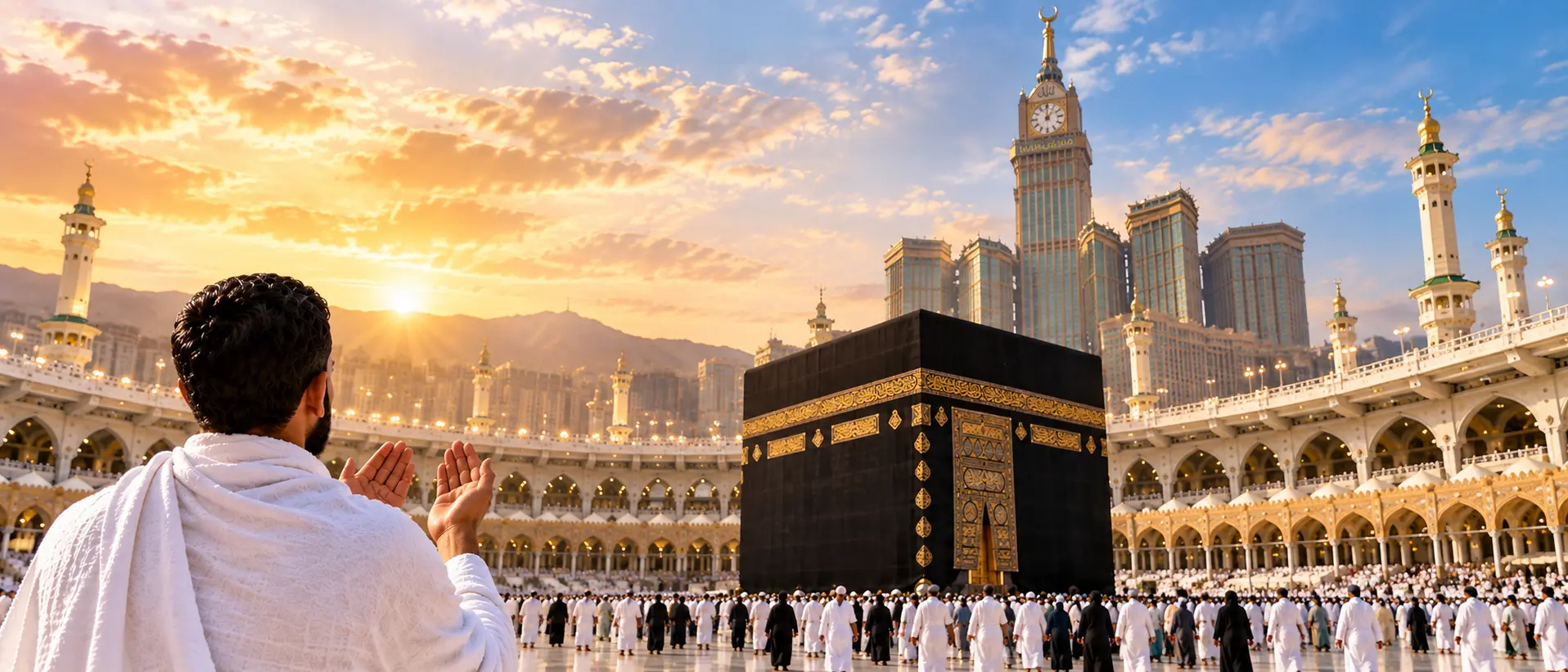
Hajj is so expensive because thousands of pounds of costs combine into one pilgrimage: peak-season flights, accommodation in Makkah and Madinah, Mina and Mashair services, food, ground transport, visa arrangements, and provider services. For UK pilgrims, recent Hajj packages have typically been advertised from around £4,500 for lower-cost options to £12,000+ per person for higher-level packages.
The price is also affected by something that cannot be changed: Hajj takes place during a fixed period in Dhul Hijjah. Unlike an ordinary holiday, pilgrims cannot move their journey to a cheaper month. Accommodation, flights, transport, and Hajj services are therefore required by large numbers of pilgrims at essentially the same time.
Why Is Hajj So Expensive?
The cost of Hajj is not one large government fee or simply an expensive hotel. It is the combined cost of several services required to complete an international Hajj journey.
Official Nusuk Hajj information confirms that an all-inclusive Hajj package can include visa issuance, flights, accommodation in Makkah and Madinah, catering, inter-city transportation, Mashair services, and guidance.
A practical UK cost picture looks like this:
Hajj expense | Typical impact on total cost |
Return flights | Major cost, particularly during Hajj travel dates |
Makkah & Madinah hotels | One of the largest package expenses |
Mina, Arafat & Muzdalifah | Dedicated Hajj/Mashair services |
Ground transport | Buses, transfers and inter-city travel |
Food & catering | Included in many all-inclusive arrangements |
Hajj visa & administration | Often incorporated into the package |
Guidance & provider services | Included depending on package |
Typical complete UK package | Around £4,500–£12,000+ per person |
The £4,500–£12,000+ figure is a current market benchmark, not an official fixed Hajj price. Nusuk doesn't set a single package price because authorized providers offer different categories and services.
Hajj Takes Place During One Fixed Period
One of the biggest reasons Hajj costs so much is that it cannot be performed throughout the year.
The main rites take place on prescribed days of Dhul Hijjah. International pilgrims therefore need flights, hotels, food, transport, and pilgrimage services within the same limited period.
This creates a very different cost environment from ordinary travel, when travelers can choose off-peak dates and find cheaper flights and hotels.
Flights Are Part of the High Hajj Expense
International airfare is a substantial part of what UK pilgrims pay. Demand for travel to Saudi Arabia rises around Hajj because pilgrims need to arrive within the permitted pilgrimage schedule.
Actual airfare depends on the UK departure airport, airline, route, baggage allowance, and travel dates. Some Nusuk all-inclusive packages include the flight, which is why pilgrims should check whether a quoted price is flight-inclusive or land-only before comparing it with another package.
Makkah and Madinah Accommodation Can Expense Thousands
Accommodation is another major reason Hajj packages are so expensive.
Nusuk divides accommodation into different standards. Its package categories include:
Luxury: 5-star hotels
Premium: 4-star hotels
Standard: 3-star hotels or residential buildings.
Location matters as much as star rating. Nusuk's Zone A accommodation is very close to Al-Masjid Al-Haram and usually within walking distance, while Zone C is not within walking distance of the Haram or the sacred Mashair sites and may instead provide shuttle services.
A pilgrim choosing a five-star hotel close to the Haram can therefore pay considerably more than someone using shared accommodation farther away.
Mina, Arafat and Muzdalifah Add Hajj Specific Expense
Hajj is not simply a journey to a hotel in Makkah.
Pilgrims must perform rites involving Mina, Arafat and Muzdalifah, which require dedicated accommodation, catering, transportation and other Mashair arrangements.
Nusuk therefore lists Mashair services as a separate component of its all-inclusive packages.
Even Mina location differs between packages. Nusuk states that Majar Al-Kabsh Camp is approximately 300–700 meters from Jamarat Bridge, whereas Al-Muaisim Camp is approximately 4 km away. Camp location and service level can therefore contribute to the difference between lower-priced and premium Hajj packages.
Ground Transportation Adds to the Price
A Hajj pilgrim needs much more transportation than an airport transfer.
Packages can involve movement between Makkah, Madinah, and the sacred Hajj sites. Nusuk states that Makkah and Madinah are approximately 450 km apart, with buses being the default inter-city transport in most packages.
Some providers also offer upgraded options such as:
Haramain High-Speed Railway
domestic flights
private-car services
shuttle buses.
These transport choices can increase the package price, particularly when pilgrims choose upgraded or private services.
Food, Guidance and Other Services Are Also Included
The headline Hajj price can include expenses that are easy to overlook when comparing it with an ordinary holiday.
Nusuk all-inclusive packages can include catering and guidance. At the same time, providers may also offer additional services such as SIM cards, Adhahi, and enrichment tours, either within the package price or at an additional cost.
This means the advertised package price may represent several weeks of accommodation and services rather than simply airfare and a hotel room.
Why Are Hajj Packages So Expensive?
Hajj packages are expensive because they combine international flights, accommodation, food, transport, Mashair services and other pilgrimage arrangements during one fixed high-demand period. The final amount then rises or falls based on hotel quality and location, room occupancy, length of stay, Mina camp, transportation, and additional services.
This explains why one UK pilgrim may find a package around £4,500, while another package can exceed £12,000 per person. The religious rites are the same; much of the price difference comes from the level, location, and duration of the services surrounding those rites.
How Expensive Is Hajj?
For UK pilgrims, a complete Hajj package can cost approximately £4,500 to £12,000+ per person, depending on the package category and included services. No single fixed Hajj price exists because accommodation, flights, room occupancy, length of stay, Mina arrangements, and transportation can differ considerably between packages.
This means two pilgrims performing the same Hajj rites can pay thousands of pounds more or less for the services surrounding their pilgrimage.
What Makes One Hajj Package More Expensive Than Another?
The difference between a lower-cost and premium Hajj package mainly comes from flights, hotel standard and location, room occupancy, length of stay, Mina camp, transport, and additional services. A lower-priced package may use shared rooms, standard hotels and coach transport, while a more expensive package may include five-star hotels close to the Haram, fewer people per room and upgraded transport.
Hotel Standard and Location
Accommodation is one of the largest expenses within a Hajj package.
Official Nusuk package categories range from Standard accommodation in 3-star hotels or residential buildings to Premium 4-star and Luxury 5-star hotels. Accommodation location also affects the overall Price.
Hotels within walking distance of Al-Masjid Al-Haram generally command a premium compared with accommodation farther away that requires shuttle transportation.
For this reason, hotel accommodation can account for several thousand pounds of a Hajj package, particularly when both Makkah and Madinah stays are included. The exact hotel cost, however, is usually bundled into the package rather than published as a fixed price.
Number of People Sharing a Room
Room occupancy directly affects how accommodation costs are divided.
Hajj rooms are commonly sold as:
Quad sharing — 4 pilgrims
Triple sharing — 3 pilgrims
Double sharing — 2 pilgrims
Single occupancy — where available
A quad-sharing package is generally cheaper per person. At the same time, double or private accommodation can add hundreds or even thousands of pounds to the total package depending on the hotel and number of nights.
This is why pilgrims should never compare two Hajj package prices without checking the room-sharing arrangement.
Length of Stay
The number of nights included can make a substantial difference to the final cost.
Nusuk lists package structures with minimum durations of about 6 days for Mashair packages, 10 days for Non-Shifting packages, and 14 days for Shifting packages, while providers can offer longer itineraries.
A package lasting two or three weeks therefore involves considerably more accommodation, catering and related services than a shorter package.
When comparing prices, pilgrims should compare Price + number of nights + services included, rather than the headline price alone.
Mina Camp and Mashair Services
A significant part of Hajj expenditure is associated with the services required during the main Hajj days at Mina, Arafat and Muzdalifah.
These costs can cover camp accommodation, meals, transport and other Mashair services. Camp location can also influence package pricing.
For example, Nusuk identifies Majar Al-Kabsh Camp approximately 300–700 meters from Jamarat Bridge, while Al-Muaisim Camp is approximately 4 km away.
Packages offering more conveniently located camps or enhanced Mashair arrangements can therefore cost considerably more than packages using more distant standard arrangements.
Transportation
Transportation can represent several hundred pounds of the overall Hajj cost per pilgrim, depending on the itinerary and type of transport included.
A Hajj package can involve:
airport transfers
Makkah hotel transfers
Madinah transfers
transport to Mina
travel to Arafat
movement to and from Muzdalifah
transport for Jamarat
Makkah–Madinah inter-city travel
Standard packages commonly rely on shared buses and coaches. More expensive packages may include Haramain High-Speed Railway tickets, domestic flights, private vehicles or upgraded transfers.
Therefore, a package relying primarily on shared coach transportation will generally have lower transport costs than one offering faster or private alternatives.
Flights
For UK pilgrims, return flights can cost roughly £600–£1,200+ per person around the Hajj travel period, although fares can vary considerably by departure airport, airline, route, booking date, and availability.
This is also why you shouldn't compare a land-only Hajj package directly with a flight-inclusive package. Nusuk's all-inclusive package structure lets you add international flights to the complete package.
A family of four, for example, could therefore spend several thousand pounds on flights alone before considering hotels and Hajj-specific services.
Food and Catering
Food is another part of the package price that may not appear as a separate charge.
Depending on the package, pilgrims may receive hotel meals and catering during the core Hajj days. Over a stay lasting several weeks, the combined catering cost can add up quickly.
The key comparison is whether a package includes breakfast, half board, full board, or meals only during particular stages of Hajj.
Visa, Administration and Provider Services
The final Price can also incorporate the Hajj visa, booking administration, guidance and provider services.
Nusuk lists visa issuance and guidance among the services that can form part of an all-inclusive Hajj package. These costs are therefore often incorporated into the headline package price rather than presented as separate charges.
Example Hajj Expenses Breakdown
For a UK pilgrim, the overall cost can broadly be understood as follows:
Expense | Approximate Cost / Impact |
Return flights | £600–£1,200+ |
Makkah & Madinah accommodation | Potentially several thousand pounds |
Mina, Arafat & Muzdalifah services | Major package expense |
Ground transportation | Several hundred pounds |
Food & catering | Varies by stay and meal plan |
Visa & administration | Usually bundled |
Guidance/provider services | Usually bundled or package-dependent |
Complete Hajj package from the UK | Around £4,500–£12,000+ per person |
Treat these figures as practical cost ranges, not fixed Hajj charges. The exact breakdown varies by package because providers bundle individual expenses differently.
Are More Expensive Hajj Packages Better?
A more expensive Hajj package does not make the Hajj itself more valid or more rewarding simply because more money was spent. The additional cost generally pays for comfort and convenience—such as a better-located hotel, fewer people sharing a room, upgraded transport, longer stays, or enhanced Mina arrangements.
Therefore, pilgrims should compare what is actually included rather than assuming the highest-priced package is automatically the best choice.
What Is the Most Expensive Hajj Package?
There is no permanent official figure for the most expensive Hajj package. Luxury package prices vary by provider, hotel, room type, flights, duration, Mina arrangements, and optional upgrades.
For this reason, claiming one package is permanently the “most expensive Hajj package” would be misleading. Premium and luxury Hajj packages can exceed £12,000 per person, while exceptional high-end arrangements may cost considerably more.
Why Is Hajj More Expensive Than Umrah?
Hajj is generally more expensive than Umrah because Hajj takes place during a fixed annual period and requires additional services at Mina, Arafat and Muzdalifah. Umrah can be performed at different times of the year, giving pilgrims more flexibility with flights, hotels, trip duration, and overall budget.
The difference is therefore not simply that Hajj hotels or flights cost more. Hajj has an additional cost structure that Umrah does not require.
Cost factor | Hajj | Umrah |
Travel dates | Fixed Hajj period | Flexible for much of the year |
Flights | High demand concentrated around Hajj | Greater choice of travel dates |
Makkah accommodation | Very high concentrated demand | More flexibility in dates and hotel choice |
Mina accommodation | Required for Hajj rites | Not required |
Arafat services | Required | Not required |
Muzdalifah arrangements | Required | Not required |
Mashair transport | Required | Not required |
Trip duration | Often structured by package | Can be shortened to reduce cost |
Package structure | More specialised | Generally simpler |
Hajj Has Fixed Dates
One of the biggest reasons Hajj is more expensive than Umrah is the lack of flexibility over travel dates.
Hajj rites are performed on specific days of Dhul Hijjah. Millions of pilgrims therefore require flights, accommodation, transportation and pilgrimage services within the same limited period.
Umrah is different. It can generally be performed throughout much of the year, although pilgrims should consider when Umrah closes for Hajj when planning travel close to the Hajj season. This greater flexibility allows travelers to choose cheaper dates and avoid particularly expensive travel periods.
This flexibility can substantially reduce the cost of an Umrah journey.
Hajj Requires Mina, Arafat and Muzdalifah
The biggest structural difference in Hajj and Umrah costs is Mashair.
Hajj requires pilgrims to perform rites connected with:
Mina
Arafat
Muzdalifah
Jamarat
These stages require organized camps, catering, transportation, and pilgrim services.
An Umrah journey does not require this entire infrastructure. Pilgrims perform their principal rites around Al-Masjid Al-Haram, including Tawaf and Sa'i, followed by Halq or Taqsir.
Therefore, an Umrah traveler can pay primarily for flights, hotels, local transportation, and personal expenses. At the same time, a Hajj pilgrim must also pay for the specialized services required during the main Hajj days.
Hajj Accommodation Faces Concentrated Demand
Both Hajj and Umrah pilgrims need accommodation, but demand patterns differ.
During Hajj, a huge number of pilgrims require accommodation in and around Makkah during essentially the same period. Hotels closer to Al-Masjid Al-Haram can be particularly expensive, especially in higher accommodation categories.
With Umrah, pilgrims have more control over when they travel. Someone trying to reduce costs can choose a less expensive period, stay farther from the Haram, or shorten their hotel stay.
This helps explain why Hajj can cost several thousand pounds more than a typical Umrah trip.
Hajj Transportation Is More Complex
Umrah transportation can be relatively straightforward: airport transfers, hotel transfers and, where required, travel between Makkah and Madinah.
Hajj involves additional movement tied to the pilgrimage rites, including transport between Makkah, Mina, Arafat, and Muzdalifah.
Large-scale transport has to operate within tightly controlled periods while serving an enormous number of pilgrims.
This additional logistical requirement forms part of the Hajj package cost and is another reason Hajj is more expensive than Umrah.
Umrah Gives Pilgrims More Control Over Their Budget
Umrah can often be adapted to the traveler's available budget.
A pilgrim may reduce the total cost by choosing:
cheaper travel dates
economy flights
a shorter stay
shared accommodation
a hotel farther from the Haram
standard ground transport
Trip duration also makes a major difference. A pilgrim who wants to understand how long Umrah takes can distinguish the time needed to perform the rites themselves from the much longer holiday-style stays commonly sold by travel providers.
Hajj offers less flexibility because its core rites must take place on prescribed dates and require Hajj-specific arrangements.
How Much More Expensive Is Hajj Than Umrah?
For a UK pilgrim, Hajj can cost several thousand pounds more per person than Umrah. A complete Hajj package can fall around £4,500–£12,000+ per person, while an ordinary Umrah trip can often be arranged for substantially less.
There is no reliable fixed difference such as "Hajj always costs £5,000 more than Umrah." Umrah prices change with the season, flights, hotel category, and duration, while Hajj prices also depend on accommodation, room sharing, Mashair arrangements, and package level.
More accurately, Hajj has several compulsory cost components that an ordinary Umrah journey does not.
Is Hajj Always More Expensive Than Umrah?
No. Hajj is generally more expensive, but it is not automatically more expensive than every Umrah trip.
A luxury Umrah journey with business-class flights, premium hotels close to the Haram, private transport, and a long stay could cost more than a lower-category Hajj package.
However, when comparing similar travel standards, Hajj generally has a higher underlying cost structure because of its fixed dates, concentrated demand, and additional Mashair services.
Can Hajj Be Made Cheaper?
Yes, Hajj costs can be reduced, but many essential expenses cannot be avoided. Pilgrims can lower the total price by choosing shared rooms, standard accommodation, hotels farther from Al-Masjid Al-Haram, standard transport, and fewer optional upgrades.
However, essential Hajj arrangements such as accommodation, Mashair services, transport between the sacred sites, and other required pilgrimage services must still be provided.
How to Reduce Hajj Costs
Pilgrims comparing Hajj packages should focus on the services that create the largest price differences:
Choose Standard rather than Premium or Luxury accommodation.
Consider triple or quadruple sharing instead of double or private rooms.
Compare hotels farther from the Haram with more expensive walkable accommodation.
Use standard shared transport rather than private transfers or other upgrades.
Compare the number of nights included in each package.
Check whether flights are included before comparing headline prices.
Avoid optional services that are not necessary for the pilgrimage.
Compare the complete package rather than choosing solely by hotel star rating.
A lower-priced package does not necessarily mean an essential Hajj rite is missing. Much of the difference between package categories relates to comfort, convenience, accommodation, and additional services.
Is Hajj Too Expensive to Be Obligatory?
Hajj is obligatory only for Muslims who can undertake it.
Allah says in the Qur'an:
"Pilgrimage to this House is an obligation by Allah upon whoever is able among the people."
Qur'an 3:97
Financial ability is therefore relevant to the obligation of Hajj. A person who genuinely cannot afford Hajj should not assume that they must purchase an expensive package regardless of their financial circumstances.
Questions involving debt, essential household expenses, dependants, or an individual's ability to afford Hajj may require personal Islamic guidance, so consult a qualified scholar when necessary.
Is an Expensive Hajj Package Necessary?
No. You don't need an expensive or luxury Hajj package to perform Hajj.
Premium packages generally charge more for features such as five-star hotels, accommodation closer to the Haram, lower room occupancy, more convenient Mina arrangements, upgraded transport, and other additional services.
These services can make the journey more comfortable, but paying more for them does not by itself make a person's Hajj more valid.
Is Hajj Worth the Cost?
For a Muslim who is financially and physically able to perform it, Hajj is not simply another international trip. It is one of the Five Pillars of Islam and an act of worship performed in obedience to Allah.
The financial cost should therefore be separated from Hajj's spiritual value. A £12,000 package does not make the pilgrimage spiritually superior to a £5,000 package simply because it provides greater comfort.
Why Is Hajj So Expensive? Final Answer
Hajj is so expensive because millions of pilgrims need flights, accommodation, transport, food, and specialized pilgrimage services during the same limited annual period. Unlike Umrah, Hajj also requires organized services at Mina, Arafat, and Muzdalifah, adding another major cost.
For UK pilgrims, complete packages can be around £4,500 to £12,000+ per person, with luxury arrangements potentially costing more. The biggest price differences usually come from hotel location and standard, room sharing, flights, length of stay, Mina arrangements, transportation, and optional upgrades.